Why Choose a PIR Sensor Switch for Global Sourcing?
Why Choose a PIR Sensor Switch for Global Sourcing?
Global buyers increasingly choose a Pir Sensor Switch because it connects convenience, energy control, and practical automation. A person enters a hallway, the sensor detects movement, and the light responds without a hand touching the wall. That small moment can reduce unnecessary operating time in offices, warehouses, hotels, and residential projects. It also supports cleaner user experiences where switches are difficult to reach.
Lighting-controls specialist Craig DiLouie states, “The best control is the one that works without being noticed.” This principle explains why sourcing decisions must look beyond the lowest unit price. A reliable Pir Sensor Switch should provide stable detection, suitable sensing distance, adjustable time delay, and consistent performance under changing temperatures. Buyers should also examine product samples, wiring diagrams, test reports, and production records before placing large orders. Certifications matter. So do warranty terms and supplier communication.
Details become important here. A sensor that triggers beside a warm window may create false activation. A narrow detection range may leave a corridor dark. These failures are not dramatic, but users remember them. Sometimes, the specification is wrong.
Global sourcing can offer competitive pricing, scalable production, and broader design options. However, distance can hide quality problems. Factory audits, pre-shipment inspections, and controlled sample testing reduce that uncertainty. No single sensor fits every building. Careful evaluation remains necessary. The strongest choice balances detection accuracy, installation effort, product compliance, and long-term reliability. That balance makes the Pir Sensor Switch more than a component; it becomes a dependable part of the built environment.
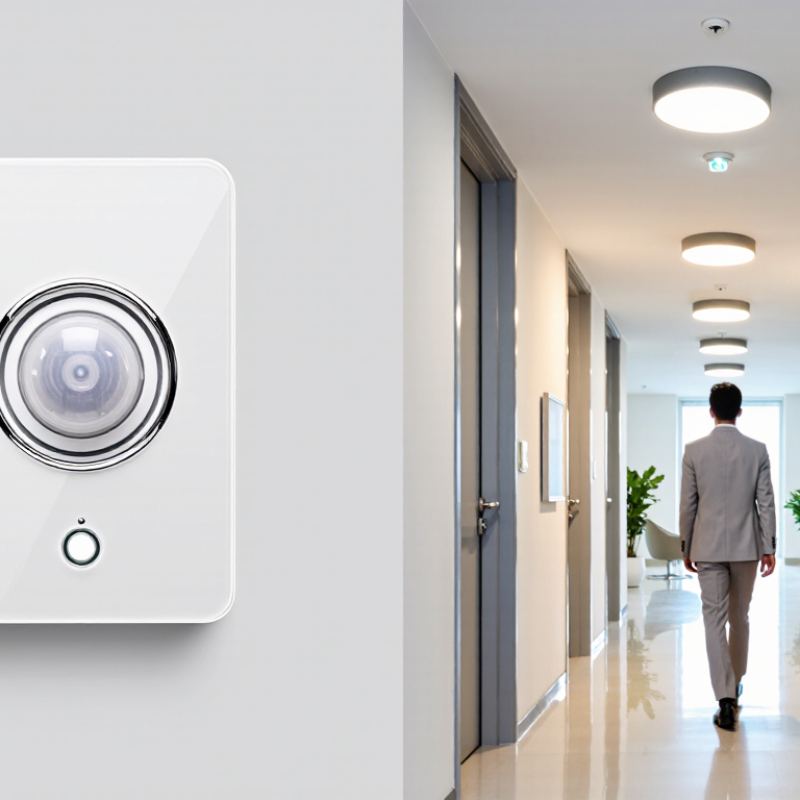
PIR Basics: 8–14 μm Detection, Passive Operation, and Switching Logic
A PIR sensor switch detects changes in infrared energy from moving people or objects. Most human-body radiation falls within the 8–14 μm wavelength range, so the sensor can respond without transmitting light or radio signals. This passive operation reduces energy use and simplifies installation in corridors, storage rooms, offices, and shared facilities. It does not “see” like a camera. It senses temperature movement across detection zones.
The switching logic is practical but not magical. When infrared changes exceed a set threshold, the circuit triggers a relay or electronic output. A timer then keeps the load active for a chosen period. Sensitivity, delay time, mounting height, and lens coverage all affect performance. During supplier evaluations, request detection-angle data, operating-temperature tests, wiring diagrams, and sample units. Test them with slow walking, warm airflow, and partial obstructions. Results can differ from the catalogue.
Tips: Confirm whether the output controls AC or low-voltage loads. Check standby current and restart behavior after power loss. Avoid placing the sensor near heaters, vents, direct sunlight, or vibrating equipment. For global sourcing, verify regional electrical requirements, documentation quality, packaging protection, and replacement availability. A low unit price may hide inconsistent calibration. Field testing is still necessary. Even experienced buyers occasionally overlook false triggering caused by moving curtains or thermal reflections.
Compare 3–7 m Range, 120° Coverage, and Adjustable Time Delay
Why Choose a PIR Sensor Switch for Global Sourcing?
A PIR sensor switch with a 3–7 m detection range fits many rooms, from compact storage areas to medium-sized offices. However, range alone does not determine performance. A 120° coverage angle can detect movement across a wide doorway or corridor. It may still miss someone standing behind a cabinet. Site layout matters more than a catalog number.
Adjustable time delay is equally important. A short delay, such as 30 seconds, can reduce unnecessary lighting in washrooms or passageways. A longer setting may suit classrooms, workshops, or loading areas. The U.S. Department of Energy reports that advanced lighting controls can deliver meaningful energy savings, but results depend on occupancy patterns and correct commissioning. The International Energy Agency’s Buildings report states that buildings consume about 30% of global final energy. Small control improvements deserve serious attention. Yet, I have seen buyers select the widest range and create false triggers near moving equipment. Bigger is not always better.
Tips: Request detection diagrams, delay settings, voltage options, and test samples before global sourcing. Check performance at 3 m and 7 m, not only in ideal conditions. Confirm whether the 120° angle changes with mounting height. Also review installation instructions and regional certification requirements. A low-cost sample can expose weak sensitivity, unstable timing, or poor terminal design early.
Measure DOE-Reported 20–60% Lighting-Energy Savings from Occupancy Control
Why Choose a PIR Sensor Switch for Global Sourcing?
DOE guidance and field studies commonly report 20–60% lighting-energy savings from occupancy control. The actual result depends on room use, operating hours, and sensor placement. A PIR sensor detects body heat and movement, then switches lights off after vacancy. In a warehouse aisle, this can prevent hours of unnecessary lighting. In a small office, savings may be lower because occupants move less frequently. The range is useful, but it is not a promise.
For global sourcing, buyers should request detection range, response time, standby power, and switching-cycle data. Test samples in rooms with glass walls, strong sunlight, and changing temperatures. These conditions can expose false triggers or missed movement. Measure baseline lighting energy before installation, then compare controlled consumption under similar schedules. The calculation is simple: (baseline kWh − controlled kWh) ÷ baseline kWh × 100. The U.S. Department of Energy and building-efficiency research groups recommend measuring real operating conditions rather than relying only on laboratory claims. A 2024 field review from Lawrence Berkeley National Laboratory also supports commissioning controls and checking user behavior. Small details matter. A poorly aimed sensor can erase expected savings. Our own site notes may be incomplete, so repeated tests are necessary. DOE data remains a strong reference, but local verification makes sourcing decisions more reliable.
Source by MOQ, IP Rating, 100,000-Cycle Life, and Traceability
Why Choose a PIR Sensor Switch for Global Sourcing?
Global sourcing should begin with measurable requirements, not attractive samples. The International Energy Agency reports that buildings consume about 30% of global final energy. A reliable PIR sensor switch can reduce unnecessary lighting runtime in corridors, storage rooms, and washrooms. The U.S. Department of Energy notes that occupancy-based lighting controls may reduce lighting energy use by 10% to 90%, depending on application and settings.
MOQ affects more than unit price. A lower MOQ supports pilot testing across different climates and installation types. Larger orders may improve pricing, but they can also magnify defects. Ask suppliers to provide detection-range data, warm-up behavior, and failure records. Confirm the required IP rating under IEC 60529. IP20 may suit a dry office, while IP44 or higher is more suitable for humid areas. The wrong rating becomes expensive quickly.
A 100,000-cycle life claim needs evidence. Request endurance-test conditions, load type, switching interval, and sample size. It is not enough to print a large number on a datasheet. Batch traceability should connect each unit to components, firmware, inspection results, and production dates. QR-based records can simplify audits and replacement decisions. In practice, suppliers sometimes report optimistic test results. Independent sampling and pre-shipment inspection remain worthwhile. Even careful sourcing leaves some uncertainty.