Connect with us today to learn more about our industrial automation solutions—and how to commission them for your application.
Why Choose a Steel Frame Carport for Your Property?
A Steel Frame Carport can add practical shelter without enclosing the whole parking area. It can protect a vehicle from sun, rain, falling leaves, and light hail, while keeping the driveway open and accessible. The frame’s strength depends on more than the steel itself. Roof connections, anchoring, drainage, and local wind or snow conditions all matter. A solid design starts with the property, not a catalogue picture.
For a transparent expert-style perspective, here is an illustrative line—not a verified quotation—attributed to fictional steel-structure consultant Alex Morgan: “A carport is only as dependable as its anchors, connections, and drainage.” That principle is worth keeping in view. A poorly placed downspout can leave puddles beside a walkway; a frame poorly suited to the site may need costly changes. Still, no structure is maintenance-free. Fasteners deserve periodic checks, and protective coatings can wear over time.
This outline explores why owners choose steel framing, what design details affect durability, and how to compare options before installation. It also considers appearance, upkeep, and the balance between initial cost and long-term use. A steel frame may suit a home, farm, or small business, but it is not automatically the right choice for every property. Measure carefully. Review the site conditions. Then weigh the benefits against the compromises.
What Defines a Steel Frame Carport?
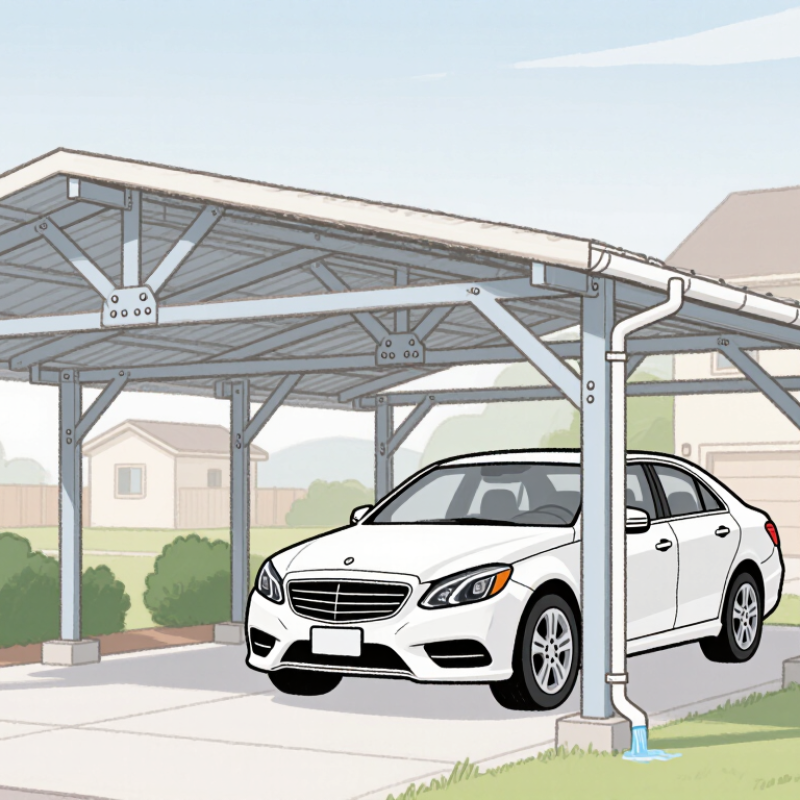
A steel-frame carport is a roofed shelter supported by a load-bearing steel skeleton. Its main parts are columns, rafters, roof purlins, bracing, base plates, and anchors. Roof panels keep off rain and sun, but the frame carries the loads. The American Institute of Steel Construction’s Steel Construction Manual, 16th Edition, lists steel’s modulus of elasticity as 29,000 ksi and its unit weight as 490 pounds per cubic foot. These reference values help engineers assess stiffness and dead load; they do not, by themselves, prove a particular carport is safe.
The frame’s shape and connections matter as much as its material. A clear span can leave room for parking, while diagonal bracing helps resist sideways movement. Column spacing, roof pitch, member sizes, and anchoring should reflect the site’s wind and snow exposure. A galvanized or coated finish can help limit corrosion, but cut edges and trapped moisture still deserve attention. “Steel frame” is not a complete specification. Ask for drawings showing member sizes, connection details, and the design loads used. A vague quote can hide important differences.
Tips: Check that posts sit on suitable foundations and anchors match the frame design. Look closely at joints and coating after installation. Small gaps can matter.
How Steel Frames Support Structural Strength and Durability
A steel-frame carport gains strength through its load paths, not thickness alone.
Roof purlins transfer snow and wind loads to rafters, then columns, anchors, and the foundation. ASTM A500/A500M specifies minimum yield strength of 46 ksi and tensile strength of 62 ksi for Grade C square or rectangular tubing. These are material-test values, not a guarantee of a carport’s capacity. That distinction matters. Span, bracing, connections, and local weather loads all affect performance.
Steel resists splitting and warping, but corrosion can gradually reduce its strength. Protective coatings help, especially around welds, cut edges, and fasteners. Drainage matters too. Look closely after storms. A loose anchor or water-trapping base can weaken an otherwise sturdy frame. Installation details are sometimes treated as minor, and that deserves a second look. Ask for documented wind and snow design loads, member sizes, connection details, and anchorage. On exposed sites or areas with drifting snow, a local engineer’s review can help confirm the frame suits the conditions.
Which Property Needs Can a Steel Carport Address?
Which property needs can a Steel Carport address? A steel carport can protect a parked vehicle from hail, sun, and rain without enclosing a garage. That matters. NOAA’s National Severe Storms Laboratory estimates that hail causes about $1 billion in damage to U.S. property and crops each year. For homes with narrow garages, extra vehicles, or a driveway exposed to storms, a roofed shelter can provide useful everyday cover. It can also keep firewood, bicycles, or garden equipment drier and easier to reach. Measure the turning space carefully; a shelter that crowds the driveway may create a new problem.
Small farms and workshops may need covered space for trailers, tools, or equipment that cannot fit indoors. Steel framing can span open areas, but the structure still needs suitable roof design, bracing, and anchors. ASCE/SEI 7-22 provides site-specific criteria for wind, snow, and rain loads used in structural design. Local conditions matter. A coastal gust and a heavy, wet snowfall place different demands on a frame. Ask a qualified local professional to check the proposed dimensions and load requirements. The fit can be awkward on sloped ground, and steel alone does not guarantee weather protection. A poorly anchored carport may perform badly when conditions turn severe.
| Property Need | How a Steel Carport Can Help | Typical Applications | Planning Considerations |
|---|---|---|---|
| Shade and everyday weather protection for vehicles | A roof provides shade and helps shield vehicles from rain, hail, and falling debris. Open sides allow airflow and convenient access. | Driveways, residential parking areas, and designated spaces beside a home | Choose a size that fits the vehicle and allows room for doors, walking, and maneuvering. An open-sided carport does not provide the same protection as an enclosed garage. |
| Covered storage for outdoor equipment | Covered space can help keep equipment out of direct sun and precipitation while keeping it accessible. | Garden tools, bicycles, lawn equipment, and recreational gear | Consider how items will be secured and whether wind-driven rain or dust may reach them through the open sides. |
| Protection for boats, trailers, or recreational vehicles | A taller or wider structure can provide overhead cover for larger vehicles that may not fit in a standard garage. | Boat parking, travel trailers, utility trailers, and RV storage | Measure the full vehicle height and length, including rooftop equipment or accessories. Confirm access clearance and local height restrictions. |
| Durable outdoor structure with manageable upkeep | Steel framing is non-combustible and is not susceptible to rot or insect damage. Coatings and maintenance needs vary by product and exposure. | Homes, farms, workshops, and other properties needing covered outdoor space | Inspect the frame and protective finish as recommended by the supplier, especially in coastal or corrosive environments. |
| Flexible covered space for work or recreation | An open structure can offer a sheltered area for tasks or activities that benefit from shade and ventilation. | Outdoor work areas, hobby spaces, and covered seating areas | For enclosed walls, electrical work, or a change of use, check applicable building, fire, and zoning requirements. |
| Site-specific wind, snow, and rain conditions | A properly designed and installed steel carport can be specified for local conditions; performance depends on its design, materials, anchoring, and installation. | Properties in regions with seasonal storms, snow, or heavy rainfall | Check local building codes and the structure’s documented design loads. Ensure foundations, drainage, and anchoring suit the site. |
| Additional covered parking without a fully enclosed garage | A carport can create covered parking while maintaining open access and natural ventilation. | Second vehicles, guest parking, or properties with limited garage capacity | Confirm setbacks, permits, property-line requirements, and any homeowners’ association rules before construction. |
What Factors Affect Carport Design and Placement?
Why Choose a Steel Frame Carport for Your Property?
What Factors Affect Carport Design and Placement?
A steel frame carport can shelter vehicles, tools, or outdoor equipment while keeping the space open. Its design should start with the site, not a catalog image. Measure the vehicle and leave room for doors to open and people to walk around it. Check ground slope, drainage paths, and nearby trees. A low corner can collect water. Branches may drop debris or rub against the roof in strong winds. Wind exposure and snow loads can also affect frame spacing, roof pitch, and anchoring. A qualified installer can assess these conditions, though an early site sketch may need revision.
Tips: Mark the footprint with stakes or a garden hose. Watch where rainwater flows. Note the afternoon sun and keep access clear for turning or unloading. Small details matter.
Placement also depends on daily habits. A carport near the driveway may make unloading groceries easier, while one beside a workshop can shelter frequently used equipment. Consider utility lines, property boundaries, and future changes, such as adding a gate. Confirm dimensions and site requirements with qualified local professionals before installation. It is easy to assume the widest layout is always best. It may not be. A slightly narrower position can preserve garden access and make maneuvering simpler. Plan around the property’s actual use, weather exposure, and maintenance needs.
How to Compare Steel Carport Options for Your Property
Compare steel carports by checking site loads, frame thickness, coating, roof design, and anchoring—not price alone. ASCE/SEI 7-22 provides criteria for wind and snow loads. Ask for calculations that match your location and intended use. A generic rating may not reflect an exposed driveway or drifting snow. Measure twice. Check clear height with the vehicle’s roof box, and leave room for doors to open.
Frame gauge matters: a lower gauge number generally means thicker steel, but the full design matters more than one specification. Ask what corrosion protection the frame receives and how the supplier defines its warranty. World Steel Association figures report more than 650 million tonnes of steel scrap recycled annually, a useful material-life-cycle data point, though it does not prove one carport will last longer. Compare roof slope, panel orientation, drainage, and fastener details; water pooling near a post base is a small detail with real consequences. Details matter. Confirm how the frame connects to concrete, and whether your site needs engineered footings. Price comparisons are imperfect: some options include anchoring and installation, while others leave those costs to you.
Why Choose a Steel Frame Carport? Compare Common Structural Steel Options
Minimum yield strength provides one useful reference when comparing frame materials. The values below are specified minimums for the listed ASTM steel grades, not the load capacity of a finished carport.
A higher yield strength does not by itself mean a safer or better carport. Member size, structural design, connections, corrosion protection, and local wind and snow loads also matter. Confirm the specific grade and design requirements for your property.