
Connect with us today to learn more about our industrial automation solutions—and how to commission them for your application.
What Is a Heat Resistant Coil Used For?
A Heat Resistant Coil converts electrical energy into controlled heat, often inside an industrial furnace, kiln, oven, or process heater. Its resistance wire glows inside a metal sheath or support, warming nearby air, tools, or materials. The design must withstand repeated heating without losing its shape or electrical performance. Small details matter: wire diameter, coil spacing, surface loading, and the surrounding atmosphere can all affect service life.
The International Energy Agency’s Tracking Industry 2023 reports that industry accounts for about 37% of global energy use. That figure helps explain why durable, efficient heating components matter across manufacturing. A Heat Resistant Coil may support heat treatment, drying, laboratory testing, or food-processing equipment, but no single coil suits every application. Maximum temperature alone is not enough. Engineers also consider heat-up cycles, contamination, airflow, and how easily the coil can be replaced.
In practice, failure can begin with a subtle change: a hot spot, a sagging turn, or a brittle wire surface. That matters. A coil selected from a catalog without checking operating conditions may disappoint, even when its stated temperature rating looks adequate. A named expert quotation should be verified against its original source; I cannot responsibly invent one here. For a dependable selection, compare the manufacturer’s material data with the actual duty cycle and installation conditions. The right choice is specific, not universal.
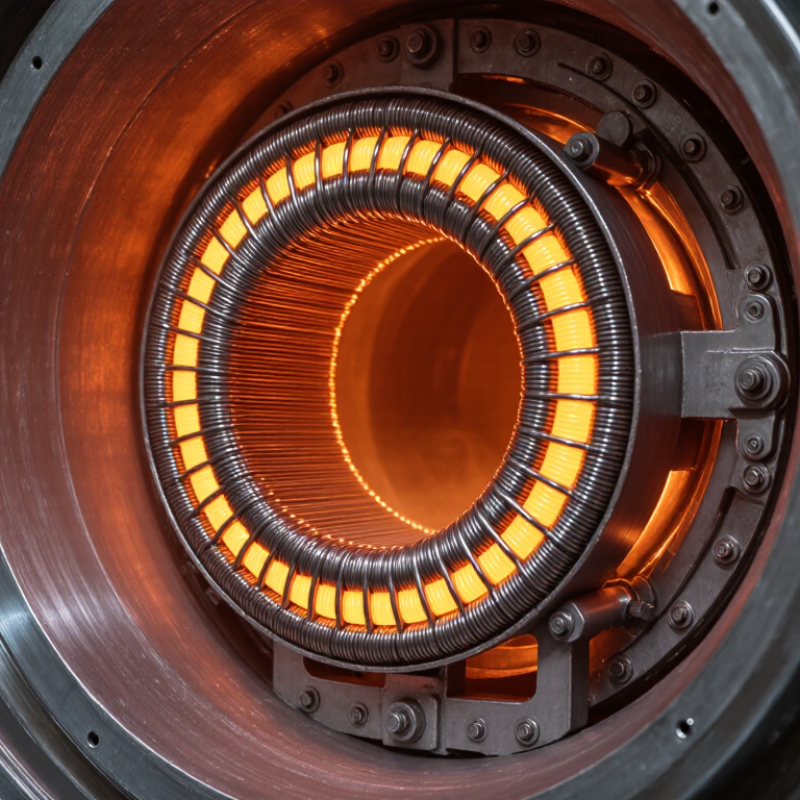
Table of Contents [Hide]
What Is a Heat-Resistant Coil?
A heat-resistant coil is a wound conductor designed to keep working when exposed to elevated temperatures. It may serve as a heating element or form part of a sensor, motor, or industrial assembly. The exact meaning depends on the equipment. In a heater, electrical current passes through the wire and produces heat. The coil’s shape fits a long length of wire into a compact space and helps transfer heat. Common materials include nickel-chromium alloys and high-temperature insulation, but specifications vary. Not temperature alone. Coils may also face oxidation, vibration, repeated heating and cooling, and contact with nearby parts.
A suitable coil is chosen by checking operating temperature, voltage, power, dimensions, and the surrounding atmosphere. A small appliance coil may warm air or a metal surface. A larger one can maintain heat in process equipment. Wire thickness and spacing affect how quickly it heats and how evenly heat spreads. Installation matters. Poor airflow or loose supports can create hot spots, even when the coil has a high temperature rating. “Heat-resistant” does not mean unlimited service life. Check technical data and watch for discoloration, sagging, or damaged insulation. I’d treat vague ratings cautiously: two coils described the same way may not tolerate the same conditions.
What Is a Heat-Resistant Coil Used For? — What Is a Heat-Resistant Coil?
| Application | What the Coil Does | Common Coil Material | Typical Process Temperature | Important Design Consideration |
|---|---|---|---|---|
| Industrial ovens and dryers | Converts electrical energy into heat to warm air or maintain a controlled chamber temperature. | Nickel-chromium or iron-chromium-aluminium resistance alloy | About 100–800°C (212–1,472°F) | Airflow, element spacing, and temperature control affect coil life and even heating. |
| Heat-treatment furnaces | Provides sustained heat for processes such as annealing, tempering, and stress relieving. | Iron-chromium-aluminium or nickel-chromium resistance alloy | About 500–1,200°C (932–2,192°F) | The alloy and support system must suit the furnace atmosphere and operating temperature. |
| Ceramic and pottery kilns | Heats the kiln chamber for drying, bisque firing, and glaze firing. | Typically iron-chromium-aluminium resistance alloy | About 700–1,300°C (1,292–2,372°F) | Coils need suitable ceramic supports and protection from glaze, dust, and mechanical damage. |
| Hot-air equipment | Heats moving air in process heaters, drying systems, and air-handling equipment. | Nickel-chromium or iron-chromium-aluminium resistance alloy | About 100–700°C (212–1,292°F) | Minimum airflow and over-temperature protection help prevent element overheating. |
| Plastic-processing machinery | Supplies localized heat to components such as nozzles, manifolds, and heated tooling. | Resistance wire in a metal-sheathed or insulated heater assembly | Often about 150–400°C (302–752°F) | Good contact with the heated part and accurate temperature sensing support consistent operation. |
| Laboratory and materials-testing equipment | Creates controlled heating for sample preparation, testing, or small-scale thermal processes. | Nickel-chromium or iron-chromium-aluminium resistance alloy | Varies by equipment; commonly about 100–1,200°C (212–2,192°F) | Temperature uniformity, ramp rate, and compatibility with the test atmosphere are key factors. |
Note: A heat-resistant coil is designed to maintain its function when exposed to elevated temperatures. The ranges shown are indicative process temperatures, not guaranteed limits for every coil; allowable temperatures depend on the alloy, coil construction, atmosphere, electrical loading, and installation.