What Are the Top Types of In Building DAS Solutions?
In Building DAS Solutions improve cellular coverage inside places where outdoor signals weaken behind concrete, glass, or steel. A basement corridor may show one bar, while a busy lobby struggles during a morning rush. A distributed antenna system brings signal deeper into a building through connected antennas and equipment. The right design depends on the building, its users, and the networks it needs to support.
The main options include passive, active, hybrid, and digital DAS. Passive systems carry radio signals through coaxial cables and splitters. They can suit smaller or less complex spaces, though cable losses may limit reach. Active systems use powered equipment, often with fiber links, to distribute signals across larger sites. Hybrid designs combine elements of both. Digital DAS converts radio signals into digital data for distribution, offering flexibility in some larger or multi-network deployments. The names can overlap in product descriptions, so specifications deserve a close read.
There is no universal winner. A hospital, office tower, and stadium face different coverage and capacity demands. Before choosing, qualified network professionals typically assess signal strength, frequency bands, user density, cable routes, and expansion plans. A walk test can reveal weak spots that floor plans miss. Small details matter. Even a polished design may need revision after installation, when real users and devices expose gaps. This guide compares the top types of In Building DAS Solutions, explains their trade-offs, and outlines practical questions to ask before selecting a system.
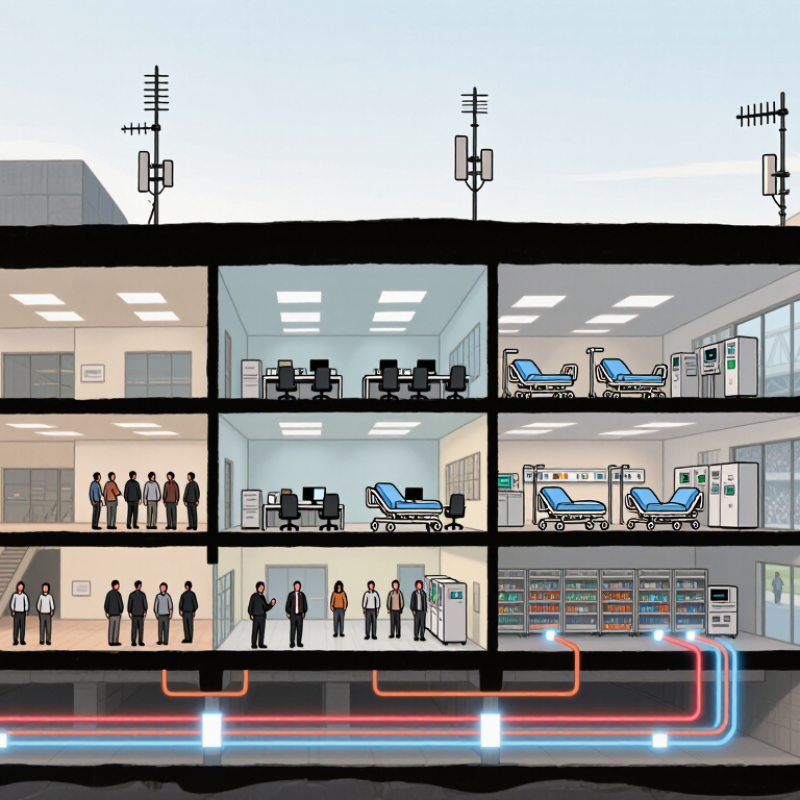
What Defines an In-Building Distributed Antenna System?
What Are the Top Types of In Building DAS Solutions?
What Defines an In-Building Distributed Antenna System?
An in-building distributed antenna system (DAS) is a network of indoor antennas that carries cellular radio signals through a building. It connects a signal source, such as an outdoor donor antenna or an on-site radio source, to antennas placed across floors and rooms. These antennas can reduce weak-signal pockets behind concrete, metal, and low-emissivity glass. A DAS extends coverage; it does not create a mobile network by itself.
At its core, a DAS includes a head-end, distribution paths, and remote antennas. Coaxial cable, fiber, or both carry signals to those antennas. Passive systems distribute radio-frequency energy without powered remote units, while active designs convert and amplify signals along the way. Hybrid layouts combine elements. The right arrangement depends on building size, frequency bands, user demand, and signal availability at the source. Details matter.
A sound design starts with measurements, not guesses. Engineers map floor plans, test signal levels, and locate trouble spots such as elevator cores, basement corridors, and crowded meeting rooms. They also assess capacity and handoff behavior; strong signal bars alone may not prevent dropped calls during busy periods. Results vary. Occupancy changes, materials differ, and drawings cannot show every reflection. Post-installation testing helps confirm coverage and identify areas that still need adjustment.
How Passive DAS Distributes Wireless Signals
Passive DAS carries wireless signals through a network of coaxial cables and passive components. At the head end, a signal source feeds the system. Splitters and directional couplers divide that signal among cable runs, while indoor antennas radiate it into rooms and corridors. Small ceiling antennas can serve offices; longer runs may reach stairwells or underground parking areas.
The distribution path itself uses no powered amplifiers. That keeps the layout relatively simple, but every cable and splitter reduces signal strength. A long cable run can leave a far-end antenna with less usable power than one near the head end. Engineers account for these losses, frequency bands, and antenna placement when sizing the system. A tidy drawing is not enough. Concrete walls and metal doors can change coverage in ways a plan may not show.
A site survey helps identify weak areas before installation, and measurements after installation can reveal unexpected gaps. Walking a hallway with a test device is useful. Still, one test route cannot represent every user or every phone model. Passive DAS distributes an available signal; it does not create new capacity or repair a poor source signal. That distinction is easy to overlook when a room simply has no bars.
How Hybrid DAS Combines Passive and Active Components
What Are the Top Types of In-Building DAS Solutions?
How Hybrid DAS Combines Passive and Active Components
Hybrid distributed antenna systems combine passive signal paths with active equipment. Passive components include coaxial cable, splitters, taps, and indoor antennas. They route radio signals through a building without adding power. Active components, such as fiber-fed remote units, help carry signals across longer distances or serve areas where cable losses would be too high. The two work together. A central equipment room can feed active units on several floors, while passive cabling connects nearby antennas. This arrangement can suit hotels, offices, and hospitals with varied layouts.
The design depends on the building, not just its floor area. Concrete walls, elevator shafts, and crowded utility spaces can weaken or block signals. A site survey helps identify coverage gaps and practical cable routes. Engineers also need to check frequency bands, signal levels, uplink performance, and equipment capacity. Too much amplification can create interference, so more power is not always better. Hybrid systems offer flexibility, but they also require careful balancing. A floor plan never tells the whole story; real conditions can be messier.
Tips: Keep cable runs short where practical, label every connection, and test coverage in occupied areas. Check stairwells and basement corners, too. Small gaps are easy to overlook. Record signal readings before and after installation, and revisit any weak spots.
How Digital DAS Supports Multiple Bands and Operators
Digital DAS supports multiple frequency bands by converting radio signals at a central headend and distributing them over fiber to remote units. Those units connect to antennas placed along corridors, in stairwells, and near busy gathering areas. The system can carry several bands through shared infrastructure, subject to equipment capacity and careful configuration. Fiber helps connect distant sections of a building without relying on long runs of coaxial cable. Placement still matters.
For multiple operators, the headend can combine approved signal sources, while filters and configured modules keep each band within its intended path. Engineers need to check frequency ranges, output levels, uplink noise, and available capacity before deployment. Commissioning should test service on each floor, not just beside an antenna. A strong signal near the equipment room proves little. Floor plans can miss concrete barriers, elevator shafts, or later renovations, so measurements may expose gaps that the initial design overlooked. That deserves a second look.
Top In-Building DAS Types: Multi-Band Coverage
Passive DAS distributes RF signals over coaxial cable and splitters; active (digital) DAS transports signals over fiber; hybrid DAS combines fiber and coax. Each can be designed to carry multiple bands and operators, depending on the equipment, spectrum authorization, and system design.
Illustrative U.S. band ranges in MHz. FDD entries show downlink ranges; TDD entries show the band range. Available spectrum and deployments vary by region and operator.
