
Connect with us today to learn more about our industrial automation solutions—and how to commission them for your application.
China Top Three Phase Transformer Manufacturers for Sale
Choosing among China’s leading Three Phase Transformer manufacturers takes more than comparing prices or polished product photos. Buyers should examine rated capacity, voltage class, cooling method, insulation system, and test documentation. A factory floor tells part of the story: look for controlled winding, clean assembly areas, and traceable inspection records. Ask how the manufacturer handles routine testing and what information accompanies each unit. Details matter.
William Stanley Jr. helped establish practical alternating-current transformer systems. The following is an editorial paraphrase of the engineering lesson associated with his work, not a verbatim quotation: “Reliable power depends on careful design, sound construction, and testing that proves the result.” It is a useful lens for this guide. A familiar brand name alone proves little.
The phrase “top three” also deserves care. Rankings can shift with product range, delivery capability, project requirements, and the evidence used to compare suppliers. One manufacturer may suit a compact commercial installation; another may offer a better fit for demanding industrial loads. Neither is automatically the right choice. This introduction considers how to assess three Chinese manufacturers for sale, focusing on practical specifications, quality evidence, customization, and after-sales support. Compare like with like. Request clear answers, verify claims against documentation, and leave room for an uncomfortable possibility: the lowest quotation may omit something important. A sound decision starts with the application, not the sales pitch.
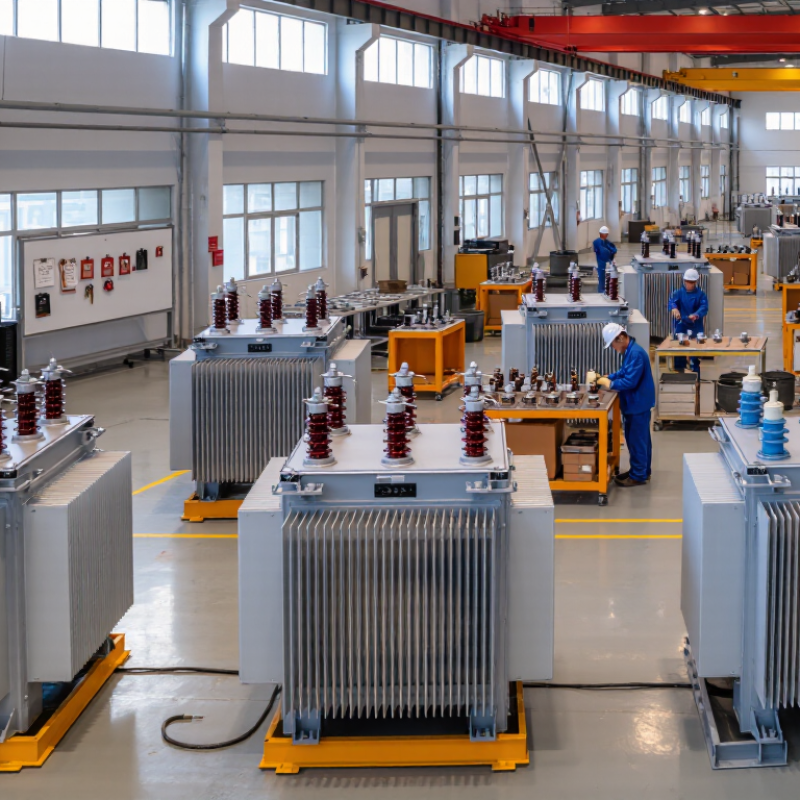
Table of Contents [Hide]
Three-Phase Transformers: Types, Applications, and Market Overview in China
Three-phase transformers support China’s transmission, distribution, factories, commercial buildings, and renewable-energy projects. Common options include oil-immersed units for outdoor substations and dry-type units for indoor installations where fire-safety and maintenance requirements shape equipment choices. At a factory, a transformer may step medium-voltage supply down for motors, production lines, and control systems. The right design depends on load profile, cooling, installation space, and operating environment—not just rated capacity.
China’s grid demand is expanding. The International Energy Agency’s Electricity 2025 report says Chinese electricity demand grew by about 7% in 2024. The National Energy Administration reported that wind and solar capacity together exceeded 1.4 billion kW by the end of that year. This growth increases the need for grid connections and suitable transformer capacity, though renewable output can vary by location and time. Selection still needs careful engineering. A rating that looks adequate on paper may not fit real peak loads. In practice, buyers should compare efficiency, temperature rise, noise, protection, and service access alongside price. Market growth is evident, but project requirements differ sharply.
China Top Three Phase Transformer Manufacturers for Sale - Three-Phase Transformers: Types, Applications, and Market Overview in China
| Category | Type or Configuration | Typical Applications | Key Selection Considerations | China Market Overview |
|---|---|---|---|---|
| Oil-immersed power transformer | Three-phase transformer with an oil-filled tank for insulation and heat dissipation | Utility substations, transmission networks, and large industrial facilities | Rated power, voltage ratio, cooling method, insulation level, losses, installation environment, and maintenance requirements | Used in outdoor substations and other applications where liquid insulation and heat transfer are suitable. Applicable product and test requirements should be checked against current Chinese standards and project specifications. |
| Dry-type transformer | Three-phase transformer using air and solid insulation rather than an insulating liquid | Commercial buildings, hospitals, transport facilities, factories, and indoor electrical rooms | Indoor clearance, ventilation, temperature rise, noise, fire-safety requirements, and load profile | Often considered for indoor installations where avoiding an oil-filled unit is a project requirement. The appropriate enclosure and ventilation depend on the site conditions. |
| Distribution transformer | Three-phase step-down transformer supplying low-voltage distribution networks | Local distribution, residential areas, commercial premises, and small-to-medium industrial loads | Primary and secondary voltage, peak and average load, impedance, efficiency, and expected load growth | A common distribution arrangement in China steps medium voltage down to low voltage; 10 kV to 0.4 kV is one widely used example, subject to the local network design. |
| Industrial transformer | Three-phase transformer selected for process loads, motor loads, or plant distribution | Manufacturing plants, mining, water treatment, and other industrial operations | Starting currents, harmonics, duty cycle, short-circuit withstand capability, and coordination with protection equipment | Industrial projects may require customized ratings and interfaces. Load measurements and the facility’s electrical design should guide specification. |
| Renewable-energy transformer | Three-phase step-up or collector transformer used in a renewable power system | Solar and wind power plants, collector systems, and grid interconnection points | Plant voltage, inverter characteristics, harmonics, ambient conditions, cooling, and grid-connection requirements | Renewable projects use transformers to connect generation equipment to collection and grid networks. Requirements vary by project design and connection rules. |
| Special-purpose transformer | Transformer designed for a defined electrical process or operating condition | Furnaces, rectifiers, traction systems, test facilities, and other specialized loads | Waveform, duty cycle, load variation, cooling, insulation, and any required electrical isolation | These units are generally specified around the process and site requirements rather than selected solely by a standard distribution rating. |
| Standards and compliance | Design, manufacture, testing, and documentation for the intended application | All transformer installations | Confirm applicable GB/T or other required standards, routine and type-test documentation, and project acceptance criteria | The GB/T 1094 series covers power-transformer requirements and related tests. Buyers should verify the applicable edition and any additional grid, industry, or project requirements. |
| Procurement and comparison | Technical and commercial evaluation of supplier quotations | New installations, replacement projects, and capacity upgrades | Compare guaranteed losses, temperature rise, sound level, accessories, delivery scope, warranty, test records, and service support | Specifications and prices depend on rating, voltage, insulation and cooling design, materials, testing scope, and delivery terms. Request comparable quotations based on the same technical specification. |
Note: Ratings, voltage levels, configurations, and compliance requirements are project-specific. The examples above describe common applications and are not a substitute for an engineered specification or confirmation against current local requirements.