
Connect with us today to learn more about our industrial automation solutions—and how to commission them for your application.
Top Ferrite Magnetic Ring Suppliers for Global Buyers
Choosing reliable Ferrite Magnetic Ring suppliers requires more than comparing prices or catalog photographs. Global buyers must examine material grades, dimensional tolerances, permeability, operating temperature, and production consistency. A ring that looks flawless may still perform poorly under high-frequency conditions. Small differences matter.
Dr. Alex Goldman, a recognized ferrite-materials specialist and author of Handbook of Modern Ferromagnetic Materials, emphasizes a practical principle: “Material choice must follow the application.” This idea guides the supplier evaluation in this article. Power transformers, EMI suppression devices, antenna systems, and signal filters demand different ferrite compositions and magnetic characteristics. Buyers should request test reports, batch records, sample approvals, and clear information about testing methods. Reliable suppliers should also explain how they control shrinkage, cracking, surface finish, and core loss during production.
Details reveal experience. Ask whether the supplier can maintain a 25.0-millimeter outer diameter across repeated batches. Confirm whether packaging protects brittle rings from edge damage during ocean transport. Check if technical support responds with measured data, not vague promises. That said, supplier claims are not always enough. Independent verification may expose gaps between laboratory results and field performance. This is where many purchasing plans become imperfect.
A strong sourcing decision balances engineering evidence, communication quality, production capacity, and long-term reliability. The best supplier is not automatically the largest. It is the partner that understands your operating conditions and admits what still requires testing.
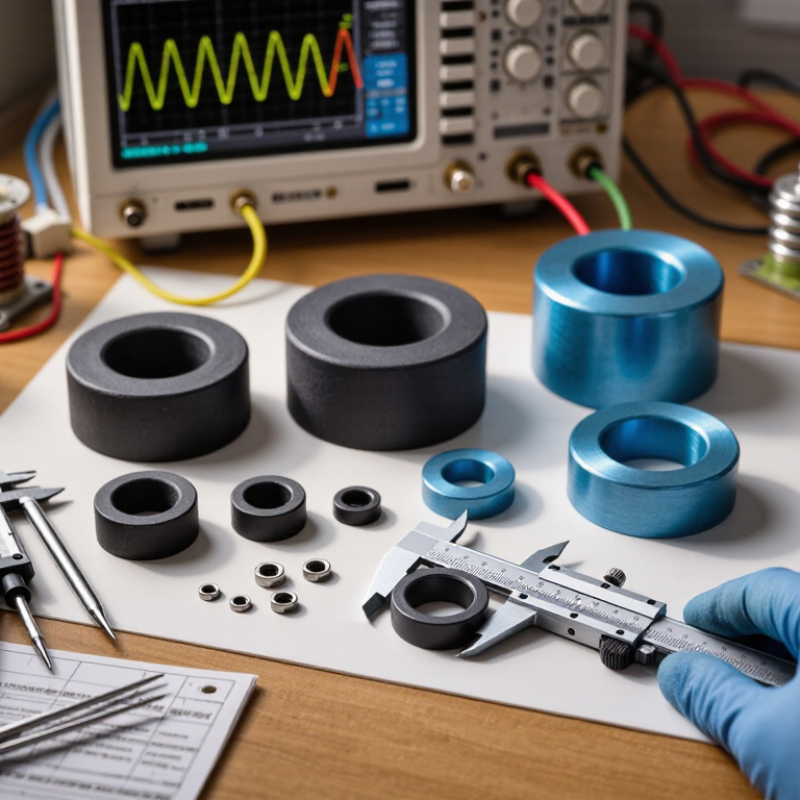
Ferrite Ring Fundamentals: MnZn and NiZn Materials Across 10 kHz–1 MHz
Ferrite rings support transformers, filters, and common-mode chokes. MnZn ferrite usually offers higher permeability and strong performance from 10 kHz into the lower hundreds of kilohertz. It suits energy transfer and noise suppression where magnetic flux changes remain moderate. NiZn ferrite has higher electrical resistivity and often performs better toward 1 MHz. Its lower parasitic capacitance can help preserve impedance at faster switching edges. The overlap is important. Material names alone cannot predict real circuit behavior.
Measure the actual core.
Tips: Ask suppliers for initial permeability, impedance curves, loss data, saturation limits, and test conditions. Check whether results use the same winding turns, temperature, and frequency range as your design. A curve tested at 25°C may shift noticeably inside a warm enclosure. I have seen clean catalog graphs create poor prototypes when the winding layout changed. That is an easy mistake. Ring dimensions also affect inductance, heat, and current handling. Compare the effective magnetic path, not only the outside diameter. For global purchasing, request inspection records and consistent batch documentation. Small material variations can change filter performance. Suppliers should explain those limits clearly.
Core Specifications: Initial Permeability, AL Value, Curie Point, and Loss
Top Ferrite Magnetic Ring Suppliers for Global Buyers
For global buyers, supplier quality begins with measurable ferrite performance. Initial permeability shows how easily the ring responds to a magnetic field. Compare values at the same temperature, frequency, and test method. A high number is not always better. Some power applications need stable permeability under strong current.
The AL value indicates inductance per turn squared, usually expressed in nH/N². It helps engineers estimate inductance before winding production parts. Ask suppliers for AL tolerance, core dimensions, and batch data. The Curie point marks the temperature where ferrite loses most magnetic ordering. Keep a safe operating margin below this point. Thermal cycling can reveal weaknesses that a single room-temperature test may miss. Loss data also deserves attention, especially at the intended frequency and flux density.
Tips: Request test curves, not only headline figures. Confirm whether losses were measured at 25°C, 100 kHz, or your actual working conditions. Check sample rings with an impedance analyzer. Small differences may expose inconsistent material lots. Test again after heat exposure. Results can surprise you.
Reliable suppliers should provide traceable reports, dimensional tolerances, and clear inspection procedures. Their technical staff should explain conflicting values without vague promises. Packaging matters too; chipped edges can change magnetic performance. I would also question unusually perfect data. Real ferrite batches show variation, and a supplier willing to discuss limits often deserves closer evaluation.
Top Ferrite Magnetic Ring Suppliers for Global Buyers - Core Specifications: Initial Permeability, AL Value, Curie Point, and Loss
Supplier-neutral comparison of commonly available ferrite ring material categories for power conversion, broadband filtering, impedance matching, and EMI suppression.
| Material Category | Typical Initial Permeability μi | Representative AL Value nH/N² | Curie Point °C | Typical Core-Loss Range | Recommended Frequency Range | Common Global-Buying Application |
|---|---|---|---|---|---|---|
| MnZn Power Ferrite Medium Permeability | 1,500–3,000 | 1,000–6,000 closed toroid | 200–250 | 150–400 kW/m³ at approximately 100 kHz, 200 mT, 100°C | 20 kHz–500 kHz | Flyback transformers, forward converters, PFC inductors, power chokes, and energy-storage cores |
| MnZn Power Ferrite Low-Loss Grade | 1,800–3,500 | 1,200–7,000 closed toroid | 220–280 | 80–250 kW/m³ at approximately 100 kHz, 200 mT, 100°C | 50 kHz–700 kHz | High-efficiency LLC converters, resonant transformers, telecom power supplies, and server power systems |
| MnZn High-Permeability Ferrite | 5,000–15,000 | 3,000–12,000 closed toroid | 120–200 | 10–60 kW/m³ at approximately 10 kHz, 50 mT, 25°C | 1 kHz–100 kHz | Common-mode chokes, current transformers, signal transformers, and low-frequency noise filters |
| MnZn Broadband Ferrite | 800–2,500 | 600–4,000 closed toroid | 150–220 | 30–150 kW/m³ at approximately 100 kHz, 50 mT, 25°C | 100 kHz–5 MHz | Broadband transformers, pulse transformers, LAN magnetic components, and signal isolation |
| NiZn High-Frequency Ferrite | 100–1,000 | 100–1,500 closed toroid | 200–300 | 50–250 kW/m³ at approximately 1 MHz, 50 mT, 25°C | 1 MHz–30 MHz | High-frequency transformers, RF chokes, antenna baluns, and broadband impedance components |
| NiZn EMI-Suppression Ferrite | 200–1,500 | 200–2,500 closed toroid | 200–350 | Loss is application-dependent; typically specified by impedance and attenuation rather than fixed Pcv | 10 MHz–1 GHz | High-frequency cable sleeves, signal-line suppression, connector filters, and radiated-noise control |
| High-Flux MnZn-Compatible Ferrite | 800–2,000 | 700–4,000 closed toroid | 200–280 | 100–350 kW/m³ at approximately 100 kHz, 150 mT, 100°C | 20 kHz–300 kHz | DC-biased inductors, photovoltaic inverters, electric-vehicle auxiliary converters, and high-current filters |
| Temperature-Stable Ferrite | 1,000–4,000 | 800–5,000 closed toroid | 220–300 | 50–220 kW/m³ at approximately 100 kHz, 100 mT, 100°C | 20 kHz–500 kHz | Industrial power supplies, outdoor electronics, automotive modules, and equipment with wide temperature variation |
Supplier Verification: ISO 9001, RoHS, REACH, and Lot Traceability
For global buyers, supplier verification should begin before comparing ferrite ring prices. A valid ISO 9001 certificate should match the factory’s legal entity, production site, and certification scope. Check its issue date and renewal status. A copied certificate is not evidence.
Request current RoHS and REACH declarations for the exact ferrite material, coating, and packaging. Generic statements create uncertainty. Ask whether testing covers restricted substances, SVHC communication, and recent material changes. An experienced supplier should explain these points clearly, not send unexplained files. Request test reports from competent laboratories when risk or application requirements justify them.
Lot traceability reveals how seriously a supplier controls production. Each carton should link to a batch number, production date, material record, inspection results, and shipment documents. Ask for a sample traceability record before placing a large order. During audits, compare the paperwork with labels on actual cartons.
Small gaps matter. Paper systems can still fail when operators record data late. I would treat this as a warning, not an automatic rejection. The supplier should identify the cause, provide corrective action, and show evidence of follow-up.
Good verification also includes dimensional checks, magnetic performance records, and retention samples. These details help buyers investigate cracks, inconsistent permeability, or coating changes months later. Certification supports trust, but controlled evidence builds it.
Global Supplier Comparison: MOQ, Lead Time, Capacity, and Export Coverage
Top Ferrite Magnetic Ring Suppliers for Global Buyers
Global Supplier Comparison: MOQ, Lead Time, Capacity, and Export Coverage
Global buyers should compare ferrite ring suppliers through measurable operating data. Recent market studies from Grand View Research and Fortune Business Insights report steady growth in ceramic magnet demand, driven by motors, speakers, sensors, and power equipment. That growth increases pressure on production schedules.
Typical MOQs range from 500 to 5,000 pieces for standard rings. Custom dimensions may require 10,000 pieces or more. Standard lead times often reach three to six weeks, while tooling can add two to four weeks. Ask for monthly capacity in tonnes, not only annual sales volume. A useful benchmark is 100 to 500 tonnes annually for established export-oriented factories.
Export coverage also needs verification. Suppliers should provide recent shipment records, packaging specifications, and destination-market experience. UN Comtrade trade data under HS 8505 can help buyers check international shipment patterns. However, customs data may combine different magnet types. It is not perfect.
Quality evidence matters. Request dimensional inspection reports, magnetic flux results, coating details, and batch traceability. ISO 9001 certification supports process control, but it does not guarantee every shipment. I would also test a production sample before approving a large order. A low MOQ may look attractive, yet unstable capacity can create costly delays.
RFQ Evaluation: 100 kHz Loss, ±25% AL Tolerance, and DC-Bias Performance
Top Ferrite Magnetic Ring Suppliers for Global Buyers
An RFQ should treat 100 kHz core loss as a measured condition, not a catalog promise. Ask suppliers to state flux density, temperature, waveform, and test duration. IEC 62024-2:2020 defines measurement principles for magnetic components, helping buyers compare results consistently. Without these details, identical loss figures may describe very different operating points.
The ±25% AL tolerance also needs careful review. Request the nominal AL value, test frequency, winding turns, and temperature range. IEC 60401-3:2018 supports consistent ferrite measurement terminology and methods. A supplier’s process capability report is more useful than a single inspection value. Look for lot-level data, not only a typical curve. Some RFQs overlook this.
DC-bias performance should show inductance retention against applied current. Ask for curves at room temperature and the highest expected operating temperature. A practical test uses the real winding, wire size, and switching frequency. Published industry analyses continue to identify power-density improvement as a major driver in high-frequency magnetics, but compact designs reduce thermal margin. That trade-off is easy to underestimate. A clean spreadsheet can still mislead. Require raw test conditions, sample size, and calibration dates before ranking suppliers. (References: IEC 62024-2:2020; IEC 60401-3:2018; U.S. Department of Energy, Industrial Decarbonization Roadmap, 2022.)