
Connect with us today to learn more about our industrial automation solutions—and how to commission them for your application.
Top 10 Threaded Linear Shaft Manufacturers for Global Buyers
A Threaded Linear Shaft may look simple on a drawing, yet small differences can change how smoothly a machine moves. Thread pitch, shaft straightness, surface finish, and runout all matter. So do material choice and heat treatment. For global buyers, supplier selection also means checking production consistency, inspection records, packaging, and delivery support.
Quality-management expert W. Edwards Deming is widely associated with the principle, “Quality is everyone’s responsibility.” That idea fits shaft sourcing: a reliable component depends on more than the machine shop. It depends on clear specifications, careful inspection, and communication between buyer and manufacturer. This guide compares ten manufacturers through practical criteria, including product range, customization, quality controls, and international service. Details matter.
A polished catalog is not proof of dependable performance. Ask for tolerances, material data, and inspection documentation. Check whether the supplier can explain how it controls straightness and thread accuracy across repeat orders. No list is perfect. Needs vary. A prototype buyer may value engineering help, while a high-volume purchaser may focus on repeatability and lead time. The comparison ahead offers a useful starting point, not a substitute for checking samples and specifications against the actual application.
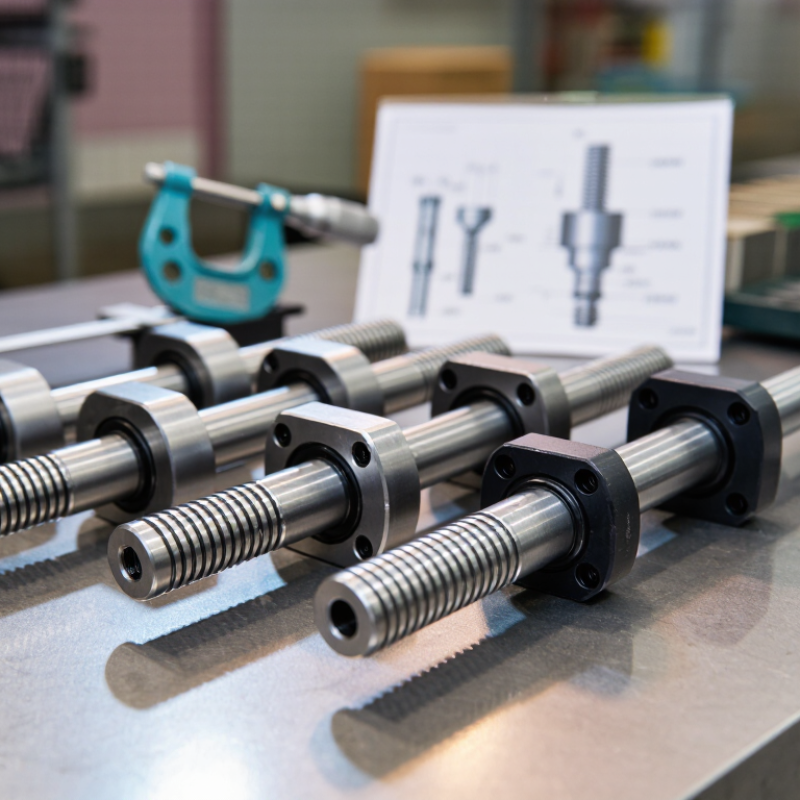
Table of Contents [Hide]
What Threaded Linear Shafts Are and Where They Are Used
A threaded linear shaft is a rod with threads that engage a matching nut. As the shaft turns, the nut travels along its length, creating controlled linear movement. Some designs use a rotating nut instead. Thread pitch affects travel per revolution, while thread form and fit influence smoothness and play. Small details matter.
These shafts appear in packaging equipment, adjustable workholding fixtures, positioning stages, and compact automation systems. Picture a carriage moving a sensor a few millimeters at a time, or a fixture screw holding a component steady during assembly. Loads, speed, travel, and operating conditions determine whether a threaded shaft is suitable. Not every shaft fits.
For reliable selection, check the required thread dimensions, usable length, straightness, surface finish, and material. Dust, moisture, and repeated cycling can affect wear, so the surrounding environment deserves attention too. Alignment is easy to underestimate; even a well-made shaft may bind if its supports are poorly positioned. I have seen specifications focus heavily on load while overlooking lubrication and installation access. That is a useful reminder: compare the drawing with the actual machine space before ordering.
Top 10 Threaded Linear Shaft Manufacturers for Global Buyers - What Threaded Linear Shafts Are and Where They Are Used
The entries below compare common threaded linear shaft products and manufacturing capabilities. They are not a ranked list of named manufacturers.
| No. | Product or capability | Typical features | Common uses | What buyers should verify |
|---|---|---|---|---|
| 1 | Precision-ground linear shaft with threaded ends | A smooth, accurately finished bearing surface with threads at one or both ends for mounting or retention. | Linear bushings, automation equipment, and fixtures requiring a fixed guide shaft. | Shaft diameter, straightness, surface finish, hardness, thread size, and usable bearing length. |
| 2 | Hardened and ground shaft | Heat-treated steel with a ground running surface; hardness and case depth depend on the specified material and process. | Repeated sliding contact in linear guides, packaging machinery, and machine tools. | Material grade, hardness test method, straightness, diameter tolerance, and corrosion protection. |
| 3 | Stainless-steel threaded shaft | Stainless grades such as 304 or 316 may be selected for corrosion resistance; suitability depends on the environment and grade. | Food-processing equipment, laboratory apparatus, and machinery exposed to moisture or cleaning agents. | Exact alloy grade, surface condition, thread standard, and compatibility with chemicals and cleaning procedures. |
| 4 | Full-length threaded rod used for linear motion | A continuous thread engages a nut to create motion; common forms include metric trapezoidal and Acme-type threads. | Manual adjusters, light-duty positioning mechanisms, and screw-driven actuators. | Thread form, lead, accuracy, nut material, load, speed, lubrication, and expected service life. |
| 5 | Lead screw and nut assembly | A screw-and-nut pair converts rotary movement into linear movement; it is distinct from a smooth guide shaft. | Positioning stages, lab equipment, and compact machine axes. | Lead accuracy, backlash, axial load, critical speed, support arrangement, and nut compatibility. |
| 6 | Hollow threaded linear shaft | A bored shaft can reduce mass or provide a passage for wiring, fluid, or other components; stiffness depends on its dimensions and design. | Compact machinery, instrument assemblies, and systems routing cables through a shaft. | Bore diameter, wall thickness, concentricity, load capacity, and end-thread geometry. |
| 7 | Custom-machined shaft ends | Ends may be turned, drilled, tapped, grooved, or fitted with shoulders to suit an assembly design. | Motor mounts, bearing supports, couplings, and equipment-specific assemblies. | Dimensioned drawings, datum locations, thread depth, edge treatment, and inspection requirements. |
| 8 | Metric or inch thread production | Metric screw-thread tolerances are addressed by ISO 965; Unified inch screw threads are covered by ASME B1.1. | Global equipment builds, replacement parts, and assemblies using regional fastener systems. | Thread designation, pitch, tolerance class, handedness, and mating-component standard. |
| 9 | Surface-finished or protected shaft | Grinding, polishing, or a specified protective treatment may be used to meet functional or environmental needs. | Sliding systems, exposed machinery, and applications where wear or corrosion control matters. | Surface-finish requirement, coating thickness if applicable, dimensional change, and compatibility with bearings. |
| 10 | Inspection and documentation capability | Manufacturers may inspect dimensions, thread fit, straightness, and surface condition against agreed drawings and tolerances. | OEM procurement, repeat production, and replacement-part sourcing. | Inspection records, material certificates when required, sampling plan, traceability, packaging, and delivery terms. |