
Top 10 Types of Copper Busbar Extrusion Machines

Copper busbars carry enormous electrical loads, yet their performance begins with a carefully controlled extrusion process. The right Copper Busbar Extrusion Machine must manage heat, pressure, speed, and dimensional accuracy together. Small process errors can create large electrical losses later.

Dr. Mark E. Schlesinger, a recognized copper and materials specialist, has observed, “Copper can be recycled repeatedly without losing its essential performance.” That principle also reflects extrusion practice: reliable production depends on material discipline, not machinery alone. This guide examines the top 10 types of Copper Busbar Extrusion Machine, including direct, indirect, horizontal, vertical, hot, cold, continuous, hydrostatic, multi-strand, and specialized precision systems.

Each machine type leaves a different fingerprint on the finished bar. A direct press may offer strong production capacity, while an indirect press can reduce friction and improve surface quality. Continuous systems suit high-volume copper rod or strip production. Vertical arrangements may save floor space, but maintenance access can become difficult. That trade-off matters.

The evaluation considers billet temperature, extrusion force, die wear, cooling control, line speed, and electrical conductivity. It also considers practical details, such as burrs along a 10-millimeter edge or uneven cooling near a water spray. These details are easy to overlook.

No machine is perfect.

Manufacturers must verify tolerances, tensile strength, surface finish, and conductivity through documented testing. Supplier claims deserve careful review. Real factory conditions often differ from brochures. This overview therefore combines engineering principles with practical judgment, while acknowledging that some recommendations require further validation for each alloy, profile, and production target.
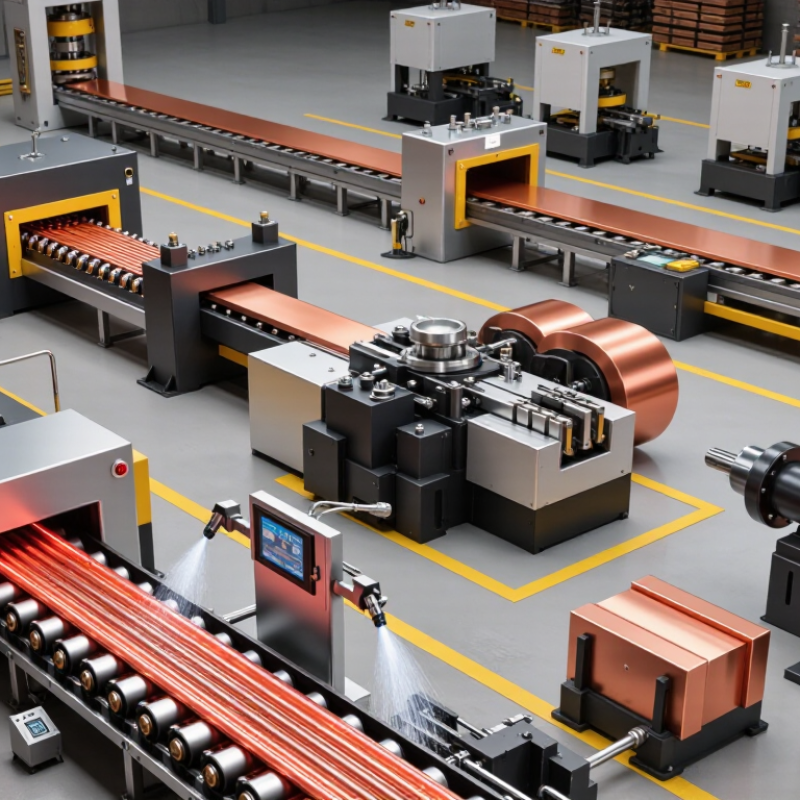
Top 10 Types of Copper Busbar Extrusion Machines

What Copper Busbar Extrusion Machines Are

Top 10 Types of Copper Busbar Extrusion Machines

What Copper Busbar Extrusion Machines Are

Copper busbar extrusion machines shape copper into flat, strong conductors through a precision die. The process may use continuous extrusion, direct extrusion, or special profile-forming systems. These machines control pressure, temperature, speed, and cooling. Their output can serve switchgear, power distribution panels, battery systems, and rail equipment.

A typical line includes a copper rod feeder, extrusion chamber, die, cooling section, straightener, and cutting unit. Die design controls width, thickness, corner radius, and hole-ready profiles. The International Energy Agency’s Global Critical Minerals Outlook 2024 projects clean-energy copper demand to rise from about 6.3 million tonnes in 2023 to nearly 10 million tonnes by 2035. That growth increases pressure on dimensional accuracy and production stability.

Tips: Check the machine’s continuous output, die-change time, temperature control, and scrap rate. Ask for conductivity results, not only production speed. A fast line can still produce inconsistent edges. In my experience, operators often underestimate die wear. That mistake can quietly reduce electrical performance and increase rework. The International Copper Study Group also reports continuing growth in refined copper use, supporting the need for efficient, measurable extrusion capacity. Yet one specification sheet cannot reveal every factory condition. Review actual test samples, cooling behavior, and maintenance records before selecting equipment.

How the Copper Busbar Extrusion Process Works

Top 10 Types of Copper Busbar Extrusion Machines

How the Copper Busbar Extrusion Process Works

Copper busbar extrusion begins with a clean copper rod or billet. The material enters a heated container under controlled pressure. A hydraulic ram then pushes copper through a shaped die. The die determines the busbar’s width, thickness, and corner profile. Direct extrusion is common, while indirect systems can reduce friction and surface damage. Temperature matters greatly. Excessive heat may soften the copper and distort the profile.

After leaving the die, the hot busbar passes through cooling equipment. Water sprays or air cooling stabilize its shape. A sizing unit corrects small dimensional changes. Rollers then guide the strip toward straightening and cutting stations. Operators inspect thickness, flatness, edge quality, and electrical resistance. Inline measurement helps detect drift before many meters become defective.

The process sounds orderly. Real production is less perfect. Slight die wear can create uneven edges or local thickness variation. Poor alignment may cause bending during cooling. These faults often begin quietly. The International Copper Study Group reported global refined copper usage above 26 million tonnes in 2023, showing the scale of demand for reliable copper products. The U.S. Geological Survey also estimated global copper mine production at about 22 million tonnes in 2024. Such volumes increase pressure for efficient extrusion, but speed should not replace inspection. A slower line can sometimes produce fewer rejected busbars and better long-term conductivity.

Top 10 Types of Copper Busbar Extrusion Machines - How the Copper Busbar Extrusion Process Works
No. Machine Type Typical Billet or Feedstock Typical Product Range Common Copper Grades Typical Operating Temperature How the Process Works Main Advantages Typical Applications
1 Horizontal Direct Extrusion Press Solid round billets, commonly 100–300 mm diameter Flat bars approximately 10–150 mm wide and 2–30 mm thick Electrolytic tough-pitch copper (Cu-ETP), oxygen-free copper (Cu-OF) 600–850 °C billet heating A heated billet is pushed directly through a stationary die by a ram. The copper and ram move in the same direction through the die opening. Flexible tooling, broad product range, and comparatively simple process control Power distribution bars, switchgear conductors, transformer components
2 Vertical Direct Extrusion Press Short copper billets, often 80–250 mm diameter Short to medium-length busbars and precision profiles up to about 100 mm wide Cu-ETP, Cu-OF, low-alloy copper 600–850 °C billet heating The billet is loaded vertically and forced through a die positioned below or above the container, reducing floor space and supporting controlled alignment. Compact layout, good guidance of the billet, and reduced bending of heavy tooling Medium-section busbars, precision copper sections, specialized electrical profiles
3 Indirect Extrusion Press Solid billets, generally 100–250 mm diameter Flat and shaped sections commonly 10–120 mm wide Cu-ETP, Cu-OF, CuCr1, CuAg alloys 600–850 °C billet heating A hollow ram carries the die into the stationary billet. Metal flow is opposite to the movement of the die, which reduces container-wall friction. Lower friction, more uniform deformation, and improved surface quality on suitable alloys High-conductivity busbars, intricate profiles, and products requiring close dimensional control
4 Hydrostatic Extrusion Machine Rod, billet, or preform surrounded by a pressure-transmitting fluid Small and medium precision sections, typically below 60 mm in major width Cu-OF, high-purity copper, selected copper alloys Usually cold to warm processing High-pressure fluid applies nearly uniform pressure to the billet and forces it through the die, minimizing direct metal-to-container contact. Low friction, good surface finish, and suitability for difficult-to-extrude materials Specialty busbars, fine profiles, and high-precision conductive components
5 Continuous Copper Extrusion Machine Continuous copper rod, commonly 8–30 mm diameter Continuous busbars approximately 5–100 mm wide and 1–20 mm thick Cu-ETP, Cu-OF, recycled high-conductivity copper Typically 400–750 °C in the deformation zone A rotating wheel or tool continuously grips the copper rod and feeds it into a chamber, where frictional work and pressure force the material through a fixed die. Continuous production, high material utilization, and no billet butt discard Long-length busbars, electrical conductors, grounding bars, and laminated-bar components
6 Conform-Type Continuous Extruder Cast copper rod or prepared copper feed rod Continuous rectangular or shaped profiles up to roughly 80–120 mm across Cu-ETP, Cu-OF, selected copper alloys Approx. 500–750 °C local process temperature A grooved wheel carries the feedstock into a fixed chamber. Friction generates heat while the wheel supplies the pressure needed to extrude the copper through the die. Compact continuous line, high productivity, and efficient use of rod feedstock Power bars, contact profiles, telecommunications conductors, and electrical strip
7 Multi-Strand or Multi-Outlet Extrusion Machine One large billet or continuous feed divided through multiple die outlets Several identical bars produced simultaneously; each outlet commonly 10–80 mm wide Cu-ETP, Cu-OF 600–850 °C for hot billet processes A multi-hole die or parallel die arrangement divides the copper flow into two or more synchronized product streams. Higher output per press cycle and efficient production of standardized sections High-volume switchboard bars, standard grounding bars, and repeated conductor profiles
8 Precision Micro-Extrusion Machine Small billets, wire, rod, or preformed copper slugs Sections typically below 20 mm wide, with thin walls or fine grooves Cu-OF, Cu-ETP, precipitation-hardening copper alloys Cold to warm; often below 600 °C Small feedstock is accurately metered into a close-tolerance die, with controlled lubrication, alignment, and cooling to maintain fine dimensions. Excellent dimensional control, low material consumption, and fine detail capability Miniature busbars, battery interconnects, electronic power contacts, and compact terminals
9 Hot Extrusion Line with Online Quenching Heated copper billets or preforms Flat bars commonly 20–200 mm wide and 3–40 mm thick CuCrZr, CuCr1, CuAg, and other heat-treatable copper alloys 650–900 °C, alloy dependent The billet is extruded hot and rapidly cooled after die exit. Controlled quenching helps retain a desired balance of conductivity, strength, and hardness. Suitable for stronger copper alloys and integrated control of post-extrusion properties High-strength busbars, welding electrodes, rail equipment, and demanding power systems
10 Tandem Extrusion and Sizing Line Hot-extruded bar from a primary press or continuous extruder Long-length bars generally 10–150 mm wide and 2–30 mm thick Cu-ETP, Cu-OF, CuCr1, CuCrZr Extrusion temperature followed by controlled cooling The primary extruder forms the busbar, while downstream sizing rolls or a secondary forming unit correct width, thickness, straightness, and edge geometry. Improved dimensional consistency, straightness, surface quality, and line productivity Long precision busbars, switchgear assemblies, transformer bars, and automated cut-to-length production
Note: Operating temperatures, billet sizes, and product ranges are representative engineering ranges. Actual settings depend on copper grade, reduction ratio, die design, press capacity, lubrication, cooling rate, and required electrical and dimensional properties.

Ten Main Types of Copper Busbar Extrusion Machines

Ten Main Types of Copper Busbar Extrusion Machines

Copper busbar production uses ten main machine types: direct, indirect, continuous, conform, hydrostatic, impact, hot, warm, cold, and vertical or horizontal systems. These categories overlap. A continuous conform line may also use horizontal feeding and cold forming. That detail matters when comparing quotations.

Direct extrusion pushes a heated billet through a fixed die. Indirect extrusion moves the die toward the billet, reducing friction and improving surface quality.

Continuous and conform machines accept copper rod, making them suitable for long busbars and high-volume production.

Hydrostatic systems use pressurized fluid, while impact machines form short, precise sections quickly. Hot, warm, and cold machines differ mainly in temperature, force, finish, and dimensional control. Vertical layouts save floor space; horizontal layouts usually simplify feeding and maintenance.

The International Copper Study Group projected refined copper usage growth of about 3.2% in 2024 and 3.3% in 2025. The International Energy Agency also reports strong copper demand from grids, electric vehicles, and renewable systems. Manufacturers therefore need stable output, not impressive speed alone.

In practice, die alignment, cooling control, and billet cleanliness often decide scrap rates. A rough busbar edge can damage insulation later.

No machine is universally best. Some catalogs also mix process names with layout names, which can confuse buyers. Careful testing remains necessary.

Key Differences in Machine Design and Performance

Top 10 Types of Copper Busbar Extrusion Machines

Copper busbar extrusion machines differ mainly in frame layout, pressure delivery, and cooling control. The ten common configurations include horizontal direct, vertical direct, indirect, hydrostatic, continuous rotary, conform, multi-strand, tandem, servo-hydraulic, and short-stroke high-speed systems. Each design suits a different production challenge.

Horizontal direct machines handle long busbars efficiently and simplify die changes. Vertical models save floor space but demand careful alignment. Indirect systems reduce billet friction, which can improve surface quality and lower extrusion force. Hydrostatic machines provide stable pressure around delicate copper billets. Continuous rotary and conform designs support steady production with fewer billet interruptions. Multi-strand layouts increase output, although strand balancing can be troublesome. Tandem lines combine extrusion, sizing, cooling, and cutting in one flow.

Servo-hydraulic systems offer precise ram movement and lower idle energy use. Short-stroke machines can cycle quickly, but their smaller workspaces may limit large profiles. In practical trials, ram speed, die temperature, and puller tension often affect quality more than advertised capacity. A 1000-ton press may still produce twisted bars if cooling is uneven. That detail is easy to overlook.

Technicians should inspect billet heating, lubrication, guide rigidity, and measurement feedback. Narrow bars need stable dimensional control. Large bars need serious structural strength. I have seen production plans favor speed, then struggle with die wear and inconsistent corners. The machine must match copper grade, profile size, tolerance, and expected shift length. Cheap maintenance access is rarely cheap in practice.

How to Choose the Right Copper Busbar Extrusion Machine

Choosing the right copper busbar extrusion machine starts with the product, not the machine catalog. Define the copper grade, bar width, thickness, length, and required tolerance. A narrow electrical bar may need different tooling from a thick structural profile. Production volume matters too. Continuous extrusion suits stable, high-volume output, while direct extrusion can offer greater flexibility for varied sizes.

Check the complete line, not only the press. The die system, heating zone, cooling unit, puller, straightener, and cutting equipment must work together. Ask for proven dimensional results using your actual copper grade. Measure thickness, edge quality, surface marks, and bow after cooling. Small defects can become expensive problems during drilling or assembly. Very high speed sounds attractive. It can also increase die wear and temperature variation.

Energy use and maintenance deserve equal attention. Review motor efficiency, billet loading time, lubrication points, spare-part availability, and control-system access. A robust frame is useful, but easy inspection often saves more downtime. Request records for pressure stability, output consistency, and emergency-stop testing. No selection is perfect. A larger machine may provide capacity but waste energy on smaller bars. A cheaper die package may also require more frequent replacement. A careful trial run, with written acceptance limits, exposes these weaknesses before installation.

Learn More

Connect with us today to learn more about our industrial automation solutions—and how to commission them for your application.