
Top Infrared Thermometer Manufacturers in China

Choosing among the top Infrared Thermometer manufacturers in China requires more than comparing prices. Product accuracy, factory capability, calibration control, and after-sales support can significantly affect purchasing decisions. A reliable supplier should explain its measurement range, response time, emissivity settings, and testing process clearly. Technical documents should match the actual device.

This guide examines Chinese manufacturers serving medical, industrial, food safety, laboratory, and household applications. It considers manufacturing experience, quality systems, product certification, customization capacity, and export reliability. Some companies specialize in clinical thermometers, while others focus on high-temperature industrial measurement. The difference matters.

Look closely at factory evidence. A professional supplier should provide traceable calibration records, stable production procedures, and practical user instructions. Sample testing can reveal uneven readings, slow response, or confusing displays. Small details matter. A good enclosure should feel solid in the hand, and the battery compartment should close securely.

However, no manufacturer is perfect for every buyer. Published specifications may not reflect performance in dusty workshops, cold warehouses, or reflective metal environments. This guide therefore avoids treating marketing claims as final proof. Independent verification remains important. Buyers should request samples, review test reports, and confirm warranty terms before placing large orders. Supplier information can also change over time, so current factory audits and direct communication are still necessary. The goal is not to name one universal winner. It is to identify manufacturers that demonstrate consistent quality, transparent communication, and dependable support for specific measurement needs.
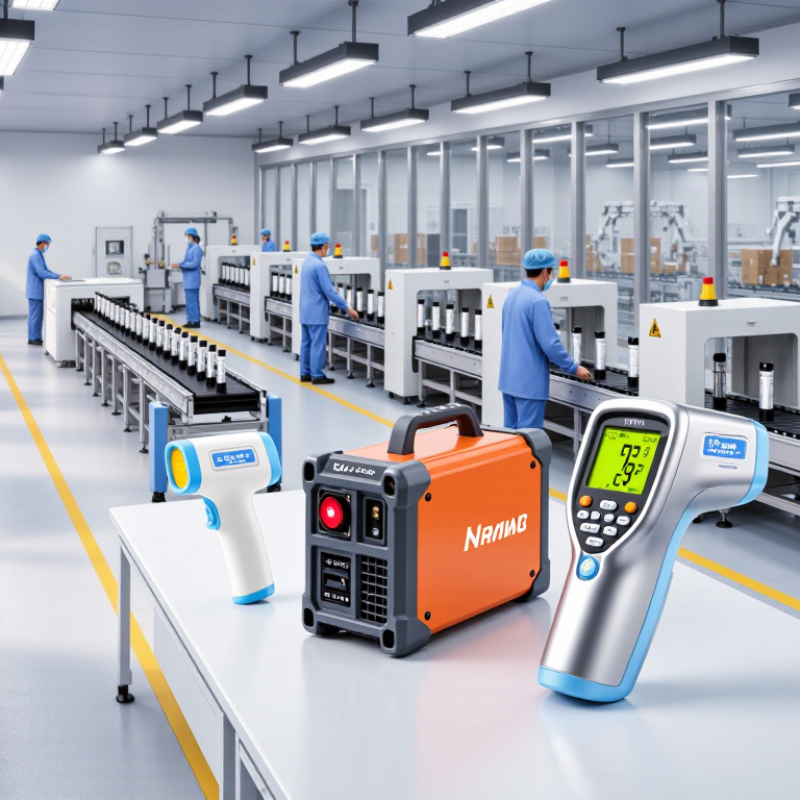
Top Infrared Thermometer Manufacturers in China

China’s Infrared Thermometer Industry: 2024 Market Scale and Growth Data

China’s infrared thermometer industry expanded steadily in 2024. Industry estimates place the domestic market near RMB 2.8 billion, including clinical, industrial, and household applications. Annual growth reached roughly 8% to 10%, supported by preventive healthcare and factory automation. The figure remains an estimate, not a single official statistic.

Medical demand stayed important, especially in clinics, pharmacies, and home-care settings. Industrial users also increased purchases for electrical inspections, food processing, and equipment maintenance. Many buyers now expect faster readings, stable calibration, and clear temperature alarms.

Small portable devices remained popular, but fixed monitoring systems gained ground in production facilities. Demand was practical.

Chinese manufacturers served both domestic buyers and overseas distributors. Export activity benefited from competitive production costs and improving sensor integration. However, price competition sometimes weakened documentation and after-sales support. That issue deserves more attention. A low purchase price can hide calibration costs, inconsistent batteries, or limited service access.

The strongest suppliers generally maintain controlled testing procedures, traceable calibration records, and clear technical specifications. Buyers should check emissivity settings, measurement distance, operating range, and accuracy at different temperatures.

In 2024, connected models also became more common, linking readings with mobile software or factory systems. Yet connectivity does not automatically improve accuracy. Real-world performance still depends on user training, surface conditions, and regular verification.

Infrared Thermometer Technology: ±0.2°C Accuracy and 0.95 Emissivity

China’s infrared thermometer manufacturers increasingly compete on measurement stability, not merely low pricing. A claimed accuracy of ±0.2°C sounds precise, but it usually applies under controlled conditions. Ambient temperature, target distance, lens cleanliness, and battery voltage can change results. Experienced buyers should request test conditions, calibration records, and a stated measurement range. Surface temperature only. It does not directly reveal core temperature.

An emissivity setting of 0.95 suits many skin, painted, rubber, and matte organic surfaces. Glossy metal is different. Reflections can produce a deceptively confident reading. Better manufacturers provide adjustable emissivity, clear distance-to-spot guidance, and stable sensors. Some models also record trends, helping technicians compare repeated readings instead of trusting one number. This practical feature is often overlooked during purchasing.

Factory quality depends on more than sensor selection. Calibration against a traceable reference, batch sampling, and final inspection matter. Ask how often calibration is checked after assembly. Independent verification can reveal differences between laboratory results and field performance. One concern remains: marketing language can simplify uncertainty. ±0.2°C may be a best-case figure, not a daily promise. Test samples in your own environment before approving large orders. That step often exposes practical weaknesses.

Leading Chinese Manufacturers by Medical, Industrial, and OEM Product Lines

China’s infrared thermometer sector now serves three distinct markets: medical, industrial, and OEM production. A 2024 Fortune Business Insights report estimated the global infrared thermometer market at roughly USD 1.2 billion in 2023, with continued growth expected through 2032. Chinese manufacturers are expanding within this demand through compact medical devices, rugged industrial sensors, and private-label assemblies.

Medical product lines commonly include forehead and ear thermometers, with fast readings, fever alerts, memory storage, and adjustable emissivity settings. Serious suppliers should demonstrate ISO 13485 quality systems, documented calibration procedures, and testing aligned with IEC 80601-2-56. Industrial manufacturers focus on wider temperature ranges, metal housings, laser targeting, and stable readings near furnaces, motors, and electrical panels. Grand View Research identifies industrial monitoring as a major infrared thermometer application, especially where contact measurement creates safety or maintenance problems.

OEM capabilities can be more important than the retail appearance. Chinese factories may provide customized firmware, molded housings, multilingual displays, packaging, and batch-level traceability. Some also support small pilot orders before larger production. This matters.

However, specifications are not always directly comparable. Accuracy may be listed under different ambient conditions, distances, or target surfaces. Buyers should request calibration records, sample testing, and clear distance-to-spot ratios. A polished catalog is not proof of field reliability. Manufacturers with transparent data, responsive engineering teams, and repeatable inspection processes offer stronger evidence of professional competence.

Factory Qualification: ISO 13485, CE, FDA, and Calibration Traceability

Top Infrared Thermometer Manufacturers in China

Factory qualification should begin with ISO 13485, not a glossy product brochure. This standard shows whether the manufacturer controls design, production, risk management, and corrective actions. During a factory audit, review batch records, training logs, complaint handling, and supplier controls. Ask to see how a rejected sensor is isolated. Small details matter.

CE marking should match the intended European market and applicable medical-device requirements. FDA compliance also requires careful checking. A manufacturer may hold FDA registration, listing, or clearance, depending on the product and its intended use. These terms are not interchangeable. Request current certificates, declaration documents, device codes, and evidence that the listed model matches the thermometer being supplied.

Calibration traceability is equally important. A reliable factory should calibrate each production sample against a controlled reference, such as a blackbody source. The certificate should show test points, measurement uncertainty, equipment identification, and due dates. Traceability should connect to recognized national or international standards. Check the serial number. It sounds obvious, but records can be incomplete. No factory is perfect. A stronger supplier admits limitations, investigates deviations, and documents corrective action instead of hiding weak results. Pay attention to calibration drift across temperature ranges, especially near clinical decision points. Consistent records build more trust than impressive claims.

Top Infrared Thermometer Manufacturers in China - Factory Qualification: ISO 13485, CE, FDA, and Calibration Traceability

Qualification Dimension Relevant Standard or Regulation What the Factory Should Demonstrate Objective Evidence to Request Recommended Acceptance Check
Medical-device quality management system ISO 13485:2016 A documented quality system covering design, purchasing, production, process control, complaint handling, corrective action, and post-market activities. Valid certificate, certification scope, issuing certification body, audit status, and site address. The certificate must cover the actual manufacturing site and the relevant thermometer product category.
European market conformity Regulation (EU) 2017/745, Medical Device Regulation A conformity assessment appropriate to the device classification, intended purpose, labeling, clinical evaluation, risk management, and technical documentation. EU Declaration of Conformity, technical documentation index, risk-management records, clinical evaluation, and, where required, Notified Body information. Confirm that the CE documentation matches the exact model, intended use, manufacturer, and applicable MDR requirements.
United States market authorization U.S. FDA medical-device requirements; applicable 510(k) pathway where required A compliant establishment, device listing where applicable, and market authorization or exemption supported by the intended use and product classification. FDA establishment registration and device listing details, 510(k) clearance number when applicable, labeling, and product identification. Verify the FDA record directly and ensure the listed product is the same model and intended-use configuration being purchased.
Calibration traceability ISO/IEC 17025; national metrology system and SI traceability principles A controlled calibration process for reference instruments, production testers, and finished thermometers, with an unbroken measurement chain. Calibration certificates showing equipment ID, measurement points, uncertainty, environmental conditions, due date, reference standards, and laboratory accreditation details. Certificates should identify the tested instrument and demonstrate traceability to national or international measurement standards.
Temperature measurement performance Applicable product specifications, risk controls, and recognized thermometer test methods Defined accuracy, repeatability, response time, operating range, emissivity assumptions, and performance limits for the stated use. Type-test reports, production inspection records, sample measurement data, and approved product specifications. Compare measured results with the approved specification at multiple temperatures and under documented test conditions.
Production process control ISO 13485:2016 quality-control and production-control requirements Controlled assembly, sensor installation, firmware loading, functional testing, labeling, packaging, and release procedures. Process flow chart, work instructions, inspection plans, lot records, operator training records, and final-release checklist. Confirm that critical process steps are documented, operator qualifications are current, and nonconforming units are segregated.
Risk management ISO 14971:2019 Identification and control of risks related to inaccurate readings, incorrect use, software, battery operation, cleaning, and foreseeable misuse. Risk-management plan, hazard analysis, risk-control verification, residual-risk evaluation, and benefit-risk assessment. Check that identified risks are linked to design controls, verification results, labeling, and post-market feedback.
Electrical safety and EMC Applicable IEC 60601-1 and IEC 60601-1-2 requirements for medical electrical equipment Electrical safety and electromagnetic compatibility appropriate to the device design and intended clinical environment. Test reports from a competent laboratory, test configuration, model identification, deviations, and final conclusions. Ensure the reports cover the final hardware, firmware, accessories, power source, and intended-use configuration.
Software and firmware control Software lifecycle and medical-device quality controls appropriate to product risk Controlled development, version management, verification, cybersecurity consideration, change approval, and release identification. Software version history, requirements, test records, change-control forms, and release documentation. The firmware version used in production should match the version covered by verification and regulatory documentation.
Supplier and component control ISO 13485 purchasing and supplier-control requirements Approval and monitoring of suppliers for infrared sensors, electronics, batteries, plastics, packaging, and other critical components. Approved supplier list, incoming inspection criteria, certificates of conformity, component specifications, and supplier audit records. Verify lot identification, incoming inspection results, approved alternatives, and change-notification procedures.
Complaint handling and post-market surveillance ISO 13485:2016 and applicable market-specific vigilance requirements A documented method for recording complaints, investigating failures, assessing reportability, implementing corrective actions, and monitoring trends. Complaint procedure, anonymized investigation examples, CAPA records, trend reports, recall procedure, and customer-feedback records. Confirm that complaints are risk-assessed, investigated within defined timelines, and linked to corrective and preventive actions.

Note: Certification, registration, clearance, and calibration documents should be verified against the exact manufacturing site, model, intended use, document validity, and issuing organization. Requirements may vary according to device classification and target market.

Product Selection by Range, Response Time, and 0.1°C Display Resolution

Top Infrared Thermometer Manufacturers in China

When selecting infrared thermometers from China, match the measuring range to the actual task. Human screening often needs a narrow range near body temperature. Industrial inspection may require several hundred degrees Celsius. A wide range is not automatically better. It can reduce sensitivity at the temperatures that matter most.

Response time deserves equal attention. A reading in 0.5 seconds supports busy clinics and production lines. However, fast readings can become unstable with movement, sweat, sunlight, or poor aiming. ASTM E1965 and ISO 80601-2-56 emphasize performance verification, not speed alone. A 0.1°C display resolution only shows smaller increments. It does not guarantee 0.1°C accuracy. NIST guidance on infrared temperature measurement also stresses emissivity, distance, and environmental control. These details are easy to overlook. I have seen specifications look excellent until testing began.

Tips: Ask for accuracy data at several temperatures, not one headline figure. Check response time under real operating conditions. Confirm calibration records, target distance, emissivity settings, and ambient-temperature limits. Review professional testing reports, such as those referenced by ASTM or ISO. A 0.1°C screen can impress buyers, but it may expose weak calibration habits. That is worth questioning.

Learn More

Connect with us today to learn more about our industrial automation solutions—and how to commission them for your application.