
Connect with us today to learn more about our industrial automation solutions—and how to commission them for your application.
How to Choose Top China Shearing Machine Blades?
Choosing top China Shearing Machine Blades requires more than comparing prices or browsing attractive product photos. A reliable Shearing Machine Blade must match the machine model, cutting thickness, material grade, blade length, and working pressure. Mild steel, stainless steel, and aluminum create different wear patterns. Harder materials demand stronger alloys and carefully controlled heat treatment. Small errors matter. A blade installed with uneven clearance may leave burrs, curved edges, or visible marks on every sheet.
Experienced buyers usually examine hardness consistency, edge straightness, surface finishing, and tolerance records. Ask the manufacturer for material certificates, heat-treatment details, inspection reports, and practical cutting references. A professional supplier should explain whether blades use tool steel, alloy steel, or customized grades. They should also provide guidance for sharpening, installation, storage, and replacement intervals. Factory photographs can help, but they do not prove production quality. Verification remains essential.
The lowest quotation may appear efficient. It may become expensive after repeated sharpening or early edge failure. However, higher prices do not automatically guarantee better performance. This is where careful comparison becomes valuable. Review sample dimensions, test-cut results, warranty terms, and communication speed. No checklist is perfect. Even experienced purchasers can overlook machine vibration or incorrect clearance settings. A dependable China supplier should welcome technical questions and admit limitations when a blade is unsuitable. The following guide explores practical selection criteria, supplier evaluation methods, and common purchasing mistakes, helping manufacturers choose blades with greater confidence and fewer costly surprises.
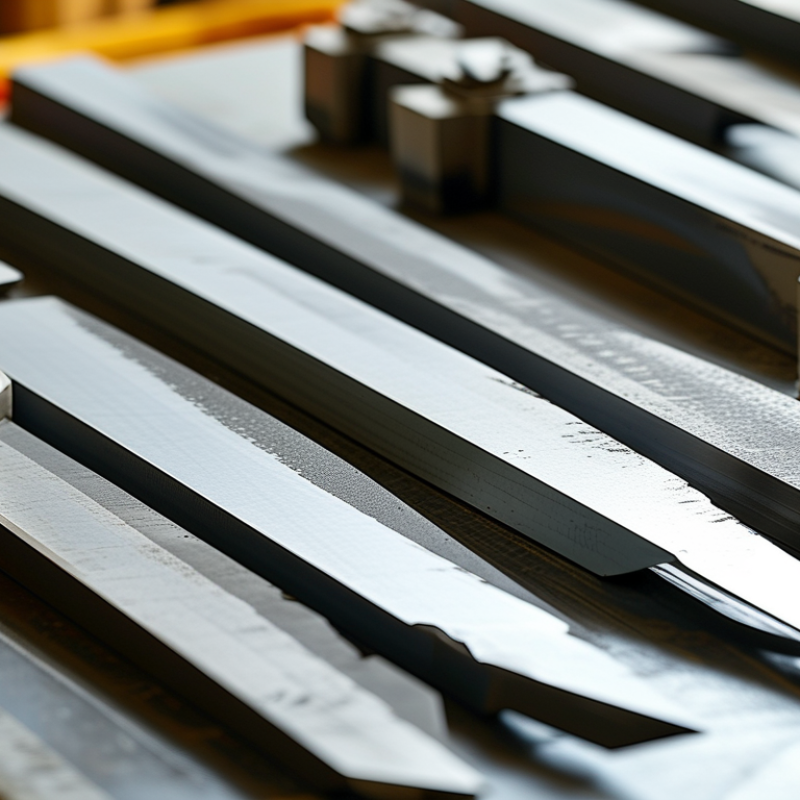
Table of Contents [Hide]
What Are China Shearing Machine Blades?
China shearing machine blades are replaceable cutting tools fitted to hydraulic or mechanical shears. They usually work as an upper blade and a lower blade. The moving edge descends, while the fixed edge supports the sheet. This creates a clean, straight cut through steel, aluminum, or stainless steel. “China” describes the manufacturing origin, not a special blade category.
Common materials include 9CrSi, 6CrW2Si, Cr12MoV, H13, and carbide-tipped grades. Material choice depends on thickness, hardness, cutting volume, and machine pressure. A 9CrSi blade may suit ordinary carbon steel. Harder alloys can better resist wear during repeated stainless-steel cutting. However, harder is not always better. Excessive hardness can increase chipping when clearance or alignment is wrong.
Industry data shows why consistency matters. The World Steel Association reported about 1.005 billion tonnes of crude steel production in China during 2024. The China Machine Tool Industry Association also continues to track strong demand for metal-forming equipment and replacement tooling. These figures indicate a large operating base, but they do not prove every blade has equal quality. In practical inspections, check edge straightness, hardness reports, grinding marks, and mounting-hole accuracy. A small burr can distort a 2-millimeter sheet. I have seen buyers focus on price and overlook cutting clearance. That mistake often produces rough edges, vibration, and premature blade damage.
How to Choose Top China Shearing Machine Blades? - What Are China Shearing Machine Blades?
| Selection Dimension | Common Options or Specifications | What the Specification Means | Recommended Selection Guidance |
|---|---|---|---|
| Blade Type | Guillotine shear blades, swing-beam shear blades, rotary shear blades, straight blades, and segmented blades | The blade geometry and mounting style must match the shearing machine structure and cutting method. | Confirm the machine type, blade mounting pattern, cutting length, and whether the blade is one-piece or segmented before ordering. |
| Blade Material | Alloy tool steel, cold-work tool steel, high-speed steel, and carbide-tipped designs | Material selection affects wear resistance, toughness, impact resistance, and service life. | Choose tougher tool steel for general mild-steel cutting and consider higher wear-resistance materials for abrasive or high-volume applications. |
| Typical Material Grades | Common tool-steel grades include 9CrSi, Cr12MoV, D2, and H13-equivalent grades | Different grades provide different balances of hardness, toughness, dimensional stability, and heat resistance. | Use the grade recommended for the workpiece and cutting frequency; request the material certificate when traceability is important. |
| Heat Treatment | Quenching and tempering, vacuum heat treatment, or controlled-atmosphere heat treatment | Proper heat treatment develops the required hardness while reducing the risk of cracking, distortion, and premature edge failure. | Ask for the heat-treatment method, measured hardness, and inspection record rather than relying only on the stated steel grade. |
| Hardness | Many industrial shear blades are supplied approximately in the range of 56–62 HRC, depending on material and application | Higher hardness generally improves wear resistance, while excessive hardness can reduce toughness and increase chipping risk. | Select hardness according to the workpiece, thickness, impact level, and machine rigidity. Verify hardness at multiple points when required. |
| Cutting Material | Low-carbon steel, stainless steel, galvanized sheet, aluminum, copper, and other non-ferrous sheet materials | Workpiece chemistry, hardness, surface coating, and abrasiveness influence blade wear and edge damage. | Provide the exact material type and tensile-strength range. Stainless and coated materials may require a more wear-resistant blade specification. |
| Maximum Cutting Thickness | Determined by the machine capacity, blade strength, blade gap, material strength, and cutting length | A blade is not selected by thickness alone; the machine must also generate sufficient cutting force and maintain correct clearance. | Match the blade to the machine’s rated capacity and the actual material thickness. Do not exceed the manufacturer’s maximum cutting range. |
| Blade Length and Dimensions | Specified by overall length, width, thickness, hole position, hole diameter, keyways, and segment size | Dimensional compatibility ensures correct installation, clamping, alignment, and safe operation. | Use an original drawing or a measured sample. Tolerances should be agreed before production, especially for mounting holes and blade thickness. |
| Cutting Edge Geometry | Single bevel, double bevel, four-edge reversible design, serrated edge, or customized edge geometry | Edge geometry influences cutting force, burr formation, edge strength, and the number of usable edges. | Choose the geometry specified for the machine model and material. Reversible blades can reduce maintenance cost when all edges are accurately made. |
| Blade Clearance | Machine-specific gap between the upper and lower blades; often adjusted according to material thickness and strength | Incorrect clearance can cause excessive burrs, deformation, blade chipping, or unnecessary cutting force. | Follow the machine maker’s clearance chart and check the adjustment mechanism after installation. |
| Dimensional Accuracy | Controlled flatness, parallelism, straightness, thickness tolerance, and hole-position tolerance | Accurate dimensions help maintain even blade contact and consistent cutting across the full cutting length. | Request a dimensional inspection report for precision applications and specify the required tolerances on the drawing. |
| Surface Finish | Ground cutting edge, polished working surfaces, and corrosion-protected non-cutting surfaces | A smooth, accurately ground edge reduces friction and helps limit burrs, scratches, and localized stress. | Check the cutting edge for grinding burns, visible cracks, dents, and uneven finishing before installation. |
| Coating or Surface Treatment | Uncoated tool steel, nitriding, chrome treatment, or selected hard coatings for specialized applications | Surface treatment can improve wear resistance, corrosion resistance, or friction behavior, but it must be compatible with the base material. | Use coatings only when their thickness, adhesion, operating temperature, and effect on edge geometry are suitable for the application. |
| Quality Documentation | Material certificate, hardness report, dimensional inspection report, heat-treatment record, and inspection images | Documentation provides evidence that the supplied blades meet the agreed technical requirements. | Request the required documents before production and define acceptance criteria for hardness, dimensions, edge condition, and packaging. |
| Packaging and Storage | Rust-preventive oil, protective wrapping, edge guards, rigid cases, and moisture-resistant packing | Proper packaging protects precision edges from corrosion, impact, and deformation during transport and storage. | Confirm that cutting edges are separately protected and that the blades are secured against movement inside the package. |
| Supplier Evaluation | Technical capability, production equipment, inspection process, delivery consistency, and after-sales support | A reliable supplier should be able to reproduce dimensions, heat treatment, edge quality, and documentation from batch to batch. | Compare technical responses and sample inspection results rather than judging only by price. A trial order can reduce compatibility risk. |
| Maintenance and Service Life | Regular cleaning, correct blade clearance, timely edge rotation, professional sharpening, and proper storage | Service life depends on both blade quality and operating conditions, including alignment, lubrication, material contamination, and cutting load. | Follow a maintenance schedule, inspect burrs and edge damage regularly, and sharpen or replace blades before severe damage occurs. |
China shearing machine blades are industrial cutting tools manufactured for guillotine, swing-beam, rotary, and related shearing equipment. The best choice should be based on machine compatibility, workpiece material, cutting thickness, blade material, heat treatment, dimensional accuracy, and documented quality control.