Connect with us today to learn more about our industrial automation solutions—and how to commission them for your application.
How to Choose the Right Anchor Drill Rig for Your Project
Choosing an Anchor Drill Rig is a ground decision before it is a purchasing decision. The right machine must match the anchor design, drilling method, access limits, and expected geology. A rig that looks powerful in a brochure may struggle on a narrow hillside track or in fractured rock. Small details matter: mast clearance beneath overhead lines, space to handle drill rods, and room for a support vehicle can shape the whole operation.
For this guide, drilling specialist Daniel Mercer offers this practical reminder: “Match the rig to the ground, the anchor, and the site—not just the depth on the plan.” This is an editorially composed field maxim, not a verified published quotation. Treat it as a prompt to check assumptions with qualified equipment suppliers and geotechnical professionals. Their experience can help connect design requirements with real site conditions.
The sections ahead compare rig types, drilling methods, power, mobility, and support needs. They also consider budget, maintenance, operator familiarity, and safety features. These factors rarely point to one perfect machine. A compact rig may reach a restricted slope, yet work more slowly in hard strata. A larger rig may drill efficiently but need access the site cannot provide. That trade-off deserves a hard look. Project data can also be incomplete, and early estimates may miss changing ground conditions. Use the selection process to identify uncertainties, ask specific questions, and confirm that the chosen Anchor Drill Rig suits the work—not merely the specification sheet.
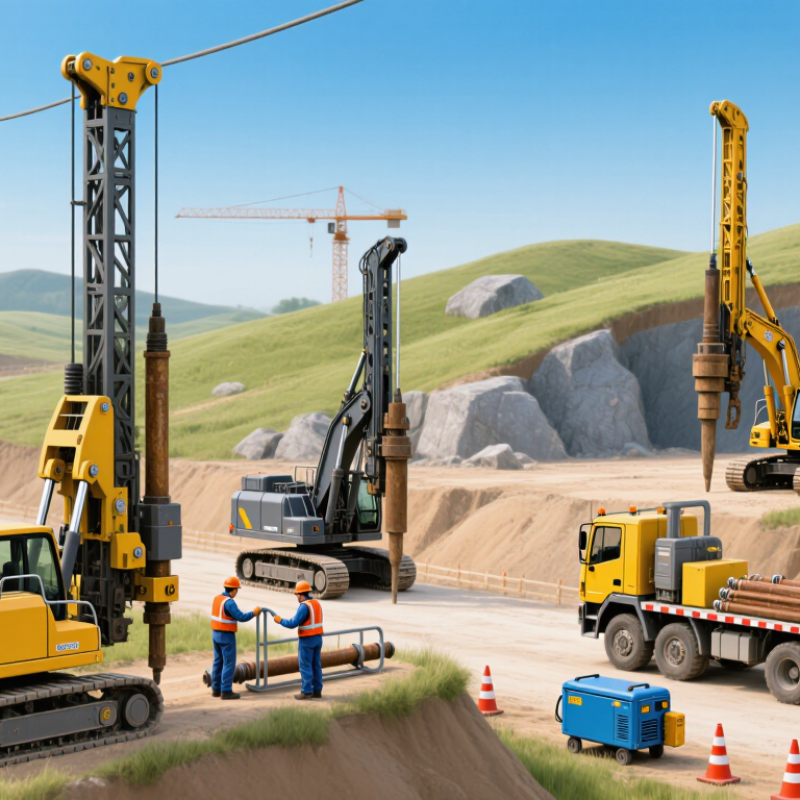
Understand Anchor Drill Rig Types and Their Applications
How to Choose the Right Anchor Drill Rig for Your Project
Understand Anchor Drill Rig Types and Their Applications
Anchor drill rigs are selected by ground conditions, hole depth, access, and required accuracy. Rotary-percussive top-hammer rigs suit many shallow-to-medium holes in fractured rock. Down-the-hole hammer rigs can maintain useful penetration in harder rock and deeper holes. Rotary rigs with casing systems are often better in loose soil, where borehole walls may collapse. The right method matters. A crawler rig may reach a steep slope, while a compact rig can fit beside a basement wall. Neither choice is automatically best.
The Federal Highway Administration’s Ground Anchors and Anchored Systems manual (GEC No. 4, 1999) describes proof testing at up to 1.33 times the design load for many anchors. This is a useful reminder: the rig must produce a borehole that supports reliable installation and testing, not just fast drilling. Check the planned anchor length, casing needs, water conditions, and working clearance before comparing rigs. A tidy specification sheet can still mislead.
Tips: Ask the contractor how the rig handles your actual soil or rock profile. Confirm rod and casing availability, mast reach, and setup space. If conditions vary sharply across the site, allow for a test hole; the first assumption may be wrong.
Assess Ground Conditions and Project Requirements
Assess the ground before comparing anchor drill rigs. Review borehole logs, SPT or CPT results, groundwater levels, and rock-core records. A sandy slope with loose fill needs different tooling from dense gravel or fractured bedrock. That matters. The rig must deliver suitable torque and feed force while keeping the mast aligned on the actual work pad, not an idealized drawing.
The Federal Highway Administration’s Ground Anchors and Anchored Systems manual (FHWA-IF-99-015, 1999) gives recommended minimum bond lengths of 15 feet for soil anchors and 10 feet for rock anchors. These are design guidance, not guaranteed dimensions for every site. Weak seams, variable rock, or groundwater may require longer bond zones and different drilling or flushing methods. Still, logs are imperfect. A short trial hole can reveal caving, water inflow, or slow penetration before the rig is committed.
Match the machine to those findings and the project’s access limits. Check maximum drilling depth, hole diameter, mast angle, compressor capacity, and the space needed for rods and spoil handling. On a narrow roadside bench, a compact rig may fit but lack the reach or flushing capacity the ground demands. On hard, jointed rock, a powerful rig can still produce poor holes if the bit and flushing system are mismatched. Record penetration rate, water loss, and hole stability during initial drilling; those field observations may challenge the assumptions in the investigation.
How to Choose the Right Anchor Drill Rig for Your Project - Assess Ground Conditions and Project Requirements
| Assessment Factor | What to Check | Rig and Tooling Considerations | Project Implications |
|---|---|---|---|
| Ground type and variability | Review borehole logs, geological mapping, and nearby construction records. Identify soil layers, loose fill, gravel, cobbles, weathered rock, and competent rock. | Select a rig and drilling system suited to the expected materials. Rotary-percussive methods are commonly used in hard or mixed ground; casing or other ground-support methods may be needed in unstable soils. | Variable ground can affect penetration rate, hole stability, tooling wear, and the need to change drilling methods during installation. |
| Groundwater and water-sensitive soils | Determine groundwater level, likely inflow, drainage conditions, and whether soils may soften, erode, or collapse when exposed to water or air. | Check whether the rig can support the required flushing method, such as air or water, and whether casing or controlled flushing is appropriate for the site. | Groundwater can affect hole stability, spoil handling, grouting, and work sequencing. Confirm the method against site conditions and environmental requirements. |
| Anchor type and installation method | Confirm whether the design calls for a drilled-and-grouted ground anchor, soil nail, rock bolt, or another anchoring system, including tendon dimensions and installation sequence. | Verify that the mast, feed system, drill string, and available tooling can accommodate the specified hole and installation arrangement. | The anchor design and installation procedure determine the required drilling capabilities; they should be confirmed before choosing a rig. |
| Required hole depth and diameter | Check the design drawings and specifications for hole depth, diameter, tolerance, and any changes in diameter required by the installation method. | Match the rig’s feed travel and compatible drill-string lengths to the design. Confirm that the available bits and casing can achieve the specified hole dimensions. | Insufficient reach or incompatible tooling can require additional rod changes, equipment adjustments, or a different rig configuration. |
| Drilling angle and working position | Identify the required inclination and direction, as well as the number of anchors to be installed at each orientation. | Choose a mast and positioning system that can safely reach the required angles while maintaining access to the drilling point. | Restricted positioning can reduce accuracy and productivity. Check the full working envelope, not just the rig’s travel position. |
| Access, clearance, and site layout | Measure access routes, overhead clearance, working-platform dimensions, turning space, ground bearing capacity, and proximity to structures or utilities. | Compare rig size, transport configuration, mast height, operating footprint, and support-equipment needs with the available site space. | Confined or sensitive sites may require a compact configuration, staged equipment delivery, or a revised work sequence. |
| Required drilling performance | Estimate the number of anchors, drilling hours, shift pattern, and expected range of ground conditions. Use project-specific production estimates where available. | Compare available torque, rotation speed, feed force, and extraction force with the tooling and ground conditions expected for the work. | Rig capacity should support the planned method without relying on maximum performance throughout the shift. Allow for rod changes, flushing, and ground variability. |
| Spoil, flushing, and environmental controls | Check how cuttings, dust, water, and drilling fluids will be collected, stored, treated, or removed. Review applicable site restrictions. | Confirm compatibility with dust collection, spoil containment, flushing equipment, and any required environmental-control systems. | Effective controls help maintain safe working conditions and reduce the risk of uncontrolled discharge or disruption to nearby operations. |
| Utilities and nearby structures | Locate underground and overhead services, review exclusion zones, and assess the risk of vibration or ground movement near existing assets. | Ensure the rig can be positioned and operated within the approved work area. Select drilling procedures in coordination with the project’s utility and monitoring plans. | Utility clearance and proximity requirements should be resolved before drilling begins; they may influence rig position, sequence, and method. |
| Transport, setup, and support | Assess delivery access, lifting arrangements, setup time, power or fuel needs, and the availability of trained operators and support personnel. | Check transport dimensions and weight, setup requirements, maintenance access, and compatibility with the site’s support equipment. | A rig that can be delivered and set up efficiently can reduce downtime, particularly where access or working hours are limited. |
Selection note: Use this table as an initial screening guide. Confirm the final rig, drilling method, and tooling with the project’s geotechnical information, anchor design, site constraints, and qualified engineering team.
Match Rig Capacity to Anchor Design and Drilling Method
An anchor drill rig should match the loads and geometry of the anchor, not just its planned depth. Check the required torque, feed force, and pullback against the anchor diameter, length, and inclination. A long, steeply inclined anchor may need a different mast reach and setup than a short vertical one. That matters. Confirm whether the rig can maintain its rated output during continuous drilling, rather than relying only on peak figures.
The drilling method changes the capacity you need. Rotary-percussive drilling through hard layers calls for suitable impact energy and a stable feed system. Cased drilling needs enough torque and pullback to advance and retrieve casing. Self-drilling anchors may call for a rig and flushing system suited to the bar and grout process. Match pumps or compressors to the method and ground conditions, too. A specification sheet can look convincing, yet overlook access limits or soft ground beneath the tracks. I have seen that detail get less attention than maximum depth. Check the working envelope, transport dimensions, and setup space against the actual site plan. If ground conditions are uncertain, leave room for adjustment rather than selecting a rig at its stated limit.
Compare Mobility, Power, and Site Access Requirements
Choosing an anchor drill rig means matching its mobility and power to the actual site, not just the anchor design. Measure gate widths, turning space, overhead clearance, and the route from unloading area to each drilling position. A compact rig may pass through a narrow access road and work beside existing structures. Its lower output, however, can extend drilling time in hard ground. Larger rigs may deliver more torque and steadier performance, but need firm ground and room to maneuver.
Tips: Walk the route before selecting equipment. Check slopes, soft ground, utility lines, and floor-load limits. Ask the operator to confirm required torque and feed force for the expected geology. Small access details matter.
Consider how the rig will move between holes. Tracks can help on uneven ground, while wheels may suit paved areas and frequent relocation. Match the power source to site conditions and available services, and plan for hoses, cables, and ventilation where relevant. A specification sheet cannot reveal every site constraint. I have seen teams focus on drilling capacity, then lose time repositioning around stored materials. Leave a little room for the unexpected; site plans are not always accurate.
Check Safety Features, Service Support, and Operating Costs
An anchor drill rig should match the ground conditions and the crew’s safety needs. Check that guards, emergency stops, hose protection, and operator visibility suit the actual work area. The U.S. Bureau of Labor Statistics recorded 1,069 fatal work injuries in construction in 2022. That figure covers the whole industry, not drilling alone, but it reinforces why safety checks matter. Test controls before the first hole.
Service support affects uptime. Ask how quickly technicians can reach the site, whether common wear parts are stocked, and what maintenance intervals apply. Then estimate fuel, tooling, transport, and downtime—not just the purchase price. The U.S. Energy Information Administration reported an average retail diesel price of $4.21 per gallon in 2023. Use it as a historical benchmark, not a current quote. I would still allow a contingency; ground conditions rarely behave perfectly.
Tip: Request a written service response time and a parts list. Compare expected daily fuel use with your planned shifts, and record actual consumption during the first week. A small log can expose assumptions that looked fine on paper.