How to Choose an Industrial Power Supply in 2026?
In 2026, choosing an Industrial Power Supply starts with the equipment, not the catalog. Identify the required output voltage, continuous load, and peak demand. A 24-volt control cabinet, for example, may draw more current when relays or motors start. Check the supply’s derating curve; rated power can fall as ambient temperature rises. Inside a warm enclosure, that detail matters.
Check the input range, efficiency, ripple, isolation, and protection against overload or short circuits. Confirm that the unit suits the installation environment, including vibration, dust, and available airflow. The datasheet is essential, but it cannot replace a practical review. Test the supply with the actual load when possible. Watch for voltage drop during startup. Small details count.
Also consider mounting, wiring access, service life, warranty, and replacement availability. Verify applicable certifications for the destination market and intended use instead of relying on broad marketing claims. A lower purchase price may bring higher heat, tighter operating margins, or longer downtime later. Compare the total cost of ownership, not just the initial quote.
There is no perfect checklist. Requirements differ between a factory floor and a sealed outdoor cabinet, and specifications can leave questions unanswered. Record assumptions, ask the manufacturer for clarification, and confirm performance under realistic conditions. A careful choice is easier to maintain—and less likely to surprise you after installation.
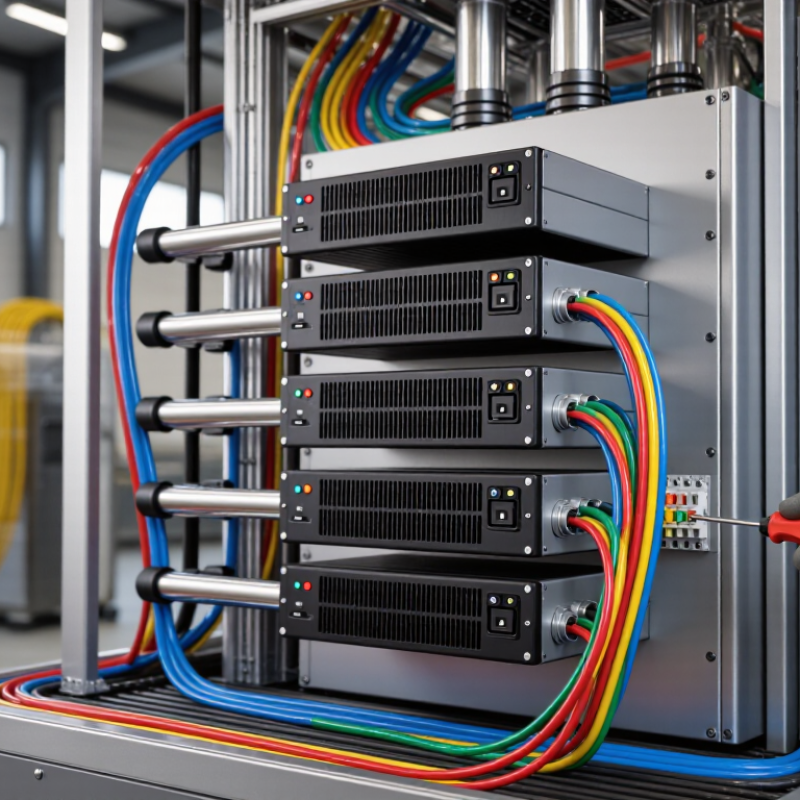
Define the Load and Operating Requirements
Define the load before comparing power-supply ratings. List every device, its operating voltage, normal current, and duty cycle. Record motor-starting current, solenoid pulses, and simultaneous startup conditions; these brief peaks can trip an undersized supply. Short peaks matter. Measure current on the actual equipment where possible, because nameplate values may not show real operating behavior. Include planned expansion, but avoid adding an arbitrary large margin. Oversizing can mean unnecessary cost, while operation near the limit leaves little room for heat-related derating.
Ambient conditions change the usable output. Check the manufacturer’s derating curve for the enclosure temperature, airflow, and installation altitude. A supply rated for a cool, open test bench may deliver less inside a warm, sealed control cabinet. Also confirm input-voltage variation, ripple tolerance, and whether sensitive controls need hold-up time during brief interruptions.
The Uptime Institute’s 2024 Annual Outage Analysis reported that 54% of surveyed organizations’ most recent significant data-center outage cost more than $100,000. This is not an industrial outage estimate, but it shows why downtime deserves a place in load planning.
Write down the assumptions, especially startup overlap; that part is easy to guess wrong.
Match Input, Output, and Power Specifications
When choosing an industrial power supply in 2026, match its input range to the actual site conditions. Check the facility’s AC voltage, frequency, and likely fluctuations, then confirm the supply accepts them. A unit designed for one nominal voltage may not tolerate frequent dips. Also consider startup conditions, especially when machinery switches on together. Small details matter.
Next, match the output to the load. Verify the required DC voltage, continuous current, and peak demand from equipment specifications. Sensors and control circuits may need clean, stable output, while motors can draw extra current during startup. Add the loads that may operate simultaneously, then allow a practical margin without greatly oversizing the unit. Oversizing is not always safer; it can affect efficiency and operating cost. Check temperature ratings, ventilation, and derating curves too. A crowded cabinet can run hotter than the workshop floor suggests.
Tips: Read the equipment nameplates and measure real operating conditions where possible. Compare the supply’s output tolerance and ripple limits with the connected devices’ requirements. Keep a little headroom. I have seen estimates miss brief startup peaks, so revisit assumptions before ordering. The calculation may still be imperfect; document what you could not verify.
Assess Environmental and Regulatory Conditions
An industrial power supply must fit the conditions around it, not just the load on its label. Record the expected temperature range, humidity, altitude, vibration, and exposure to dust or oil mist. A cabinet beside a hot motor may run much warmer than the room. Heat matters. Check the unit’s derating curve at the actual cabinet temperature and input voltage. Confirm whether airflow is available, and whether filters could clog in a dusty plant. For outdoor or washdown areas, assess enclosure protection and condensation risks; a sealed cabinet can still trap heat. Leave room for wiring and service access.
Regulatory needs depend on where the equipment will be installed and how it is used. Identify applicable safety, electromagnetic compatibility, and environmental requirements for the target markets. Ask the equipment integrator or a qualified compliance specialist to review the installation, especially when the supply is part of a larger machine. Verify current certificates and test documentation rather than relying on a sales description. Keep records of the intended operating range and mounting method. Paperwork counts. One detail is easy to miss: a compliant component does not automatically make the finished control panel compliant. Check the complete assembly and its installation conditions.
How to Choose an Industrial Power Supply in 2026? — Assess Environmental and Regulatory Conditions
Dust and accidental contact can affect power-supply selection. The chart compares standardized IEC 60529 access-probe diameters for the first IP code digit from IP1X to IP4X.
Smaller probe diameters indicate protection against access by smaller objects. These values are test-probe sizes, not dust-particle limits; IP5X and IP6X use dust-protection tests rather than this probe-size scale. Check the complete IP rating and the equipment’s operating conditions before choosing a power supply.
Source: IEC 60529, Degrees of protection provided by enclosures (IP Code).
Compare Supply Topologies, Protection, and Efficiency
How to Choose an Industrial Power Supply in 2026?
Compare Supply Topologies, Protection, and Efficiency
Choosing an industrial power supply starts with the load, not the catalogue. Linear supplies can offer low electrical noise, but they often waste more energy as heat. Switch-mode designs are usually smaller and more efficient, making them practical for control cabinets with limited space. Isolated outputs help separate circuits; non-isolated converters may suit simpler voltage changes. Check the input range, startup behavior, and response to sudden load changes.
Keep it simple.
Protection features matter when motors, relays, or long cable runs share a system. Look for overcurrent, overvoltage, short-circuit, and overtemperature protection, then confirm how the unit recovers after a fault. A brief protection trip can be useful; repeated resets may interrupt equipment. Compare efficiency at the load your machine actually uses, not just at peak output. Check the cabinet temperature and leave room for airflow.
Heat matters.
A neat datasheet comparison can still mislead: wiring resistance, dust, and uneven loading affect real performance. Measure under operating conditions where possible, and allow reasonable capacity margin without greatly oversizing the supply.
Verify Installation, Testing, and Maintenance Needs
An industrial power supply is dependable only when its installation matches real operating conditions. Check the input voltage range, output current, mounting orientation, and ambient temperature against the equipment documentation. Leave clear space around vents; a crowded cabinet can trap heat from nearby drives. Confirm wire size, terminal torque, grounding, and protective devices before energizing the unit. Small details matter.
During commissioning, measure output voltage at the supply and at the connected load. A long cable can cause a noticeable drop at the far end. Test startup behavior and representative load changes, not just an empty, steady-running system. Record the readings, instrument used, and operating conditions. A calculation may look correct on paper yet miss a warm enclosure or a brief current surge. That gap is worth revisiting.
Set maintenance checks around the environment and duty cycle. Inspect terminals for looseness or discoloration, vents for dust, and cables for wear. Compare measured output with the original commissioning record, especially after equipment changes. Keep records. One limitation: visual checks cannot reveal every internal fault, and opening a unit may create new risks. Use qualified personnel and the manufacturer’s service instructions for deeper inspection.
