What Are the Best Types of Plastic Tubes for Buyers?
Choosing the best Plastic Tube starts with its job, not its appearance. A clear tube on a showroom shelf may look suitable, yet fail under heat, pressure, or repeated bending. Buyers should match material properties to the fluid, operating temperature, pressure range, exposure to sunlight, and required flexibility. Small details matter. A tight bend can kink a soft tube, while an oversized inner diameter may reduce flow control.
Material options serve different needs. Polyethylene is often selected for flexible, general-purpose applications; polypropylene offers useful chemical resistance; PVC can provide economical clarity and flexibility; silicone suits applications requiring a broad temperature range; and PTFE is valued for demanding chemical service. These are starting points, not guarantees. Formulations and performance vary by manufacturer, so review product datasheets and request relevant test results before purchase.
The wider plastics context makes careful selection more important. The OECD’s Global Plastics Outlook (2022) estimates that global plastics production reached 460 million tonnes in 2019, while plastic waste reached 353 million tonnes that year. These figures cover plastics broadly, not tubing specifically, but they underline the value of avoiding mismatched products and premature replacement. Ask suppliers about wall thickness, dimensional tolerances, material composition, and batch consistency. For sensitive uses, confirm that the exact grade is suitable for the intended contact conditions. A specification sheet can still leave questions unanswered. Independent testing or a sample trial may reveal issues that a catalogue cannot. This guide compares common tube types and the practical trade-offs buyers should weigh before ordering.
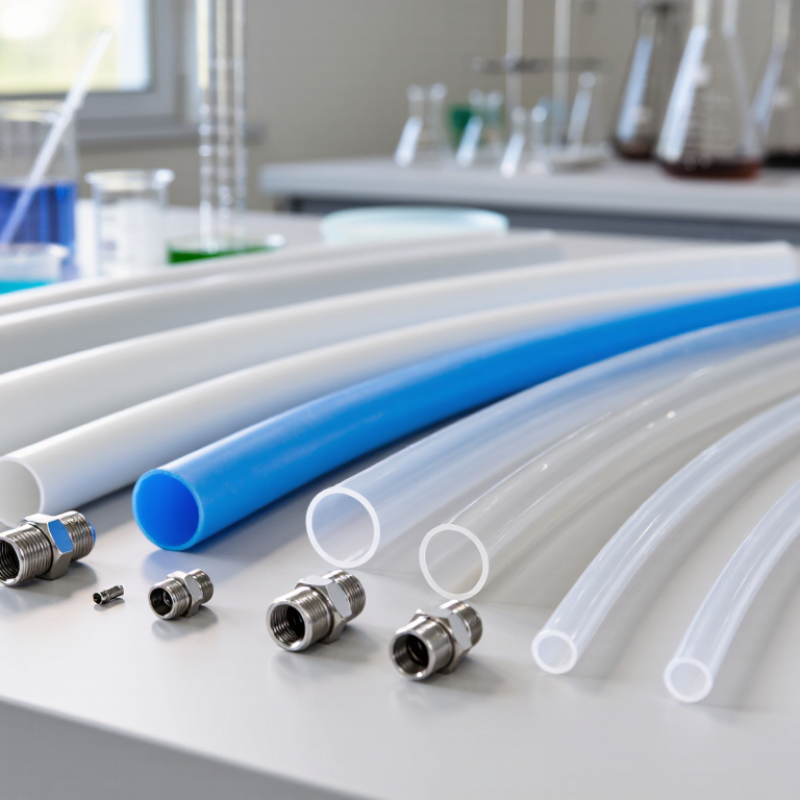
Classify PVC, CPVC, PE, PP, PEX, and Fluoropolymer Tubes by Material
PVC, CPVC, PE, PP, PEX, and fluoropolymers solve different tubing problems. PVC suits cool-water lines and general corrosion-resistant service. CPVC handles hotter water; temperature limits still depend on pressure, dimensions, and fittings. ASTM D1784 classifies rigid PVC and CPVC compounds, while ASTM D1785 specifies PVC pipe requirements. Check the actual grade, not just the resin name.
PE bends around gentle curves and resists many chemicals, making it useful for water and utility runs. The Plastics Pipe Institute’s Handbook of Polyethylene Pipe describes PE’s flexibility and long-term pressure design; installation conditions still matter. PP offers broad chemical resistance, but heat and load can change its performance. PEX is common in hot- and cold-water plumbing. PPI’s PEX design guidance gives typical ratings of 100 psi at 180°F and 80 psi at 200°F for standard tubing. That difference matters.
Fluoropolymer tubing, including PTFE and FEP, is chosen for demanding chemical, thermal, or high-purity service. It often costs more and may need careful support because some grades are flexible. A practical selection starts with fluid, temperature, pressure, and bend radius. Then verify the manufacturer’s technical data against relevant ASTM or PPI guidance. The label alone is not enough. And real installations are rarely tidy.
Compare Typical Heat Limits: PVC 60°C, CPVC 93°C, and PEX 93°C
What Are the Best Types of Plastic Tubes for Buyers?
Compare Typical Heat Limits: PVC 60°C, CPVC 93°C, and PEX 93°C
Temperature ratings can narrow a buyer’s options quickly. PVC pressure pipe is commonly limited to about 60°C (140°F), while CPVC and PEX are often rated up to 93°C (200°F). These are typical upper limits, not guarantees for every pipe or installation. Heat and pressure work together: as water temperature rises, the pipe’s allowable pressure can fall. The Plastics Pipe Institute’s PEX guidance, reflecting ASTM F876 ratings, lists 93°C at 80 psi, compared with 82°C at 100 psi and 73°C at 160 psi. That difference matters near a water heater.
CPVC can suit hotter domestic-water runs than standard PVC, but confirm the exact product’s rating and connection requirements. PEX handles temperature changes well, though its flexibility needs secure supports and protection from sharp edges. PVC may remain a practical choice for cooler water lines. I’d still check the system’s weakest component; a fitting or valve can set the real limit. Easy to overlook.
Tips: Check the pipe’s pressure-temperature chart, not just its headline maximum. Note the expected water temperature, operating pressure, and any short-term heat spikes before choosing. The ASTM standards and PPI guidance are useful references, but project conditions still matter.
Typical Maximum Heat Limits for Plastic Tubes
PVC is typically rated up to 60°C, while CPVC and PEX can reach about 93°C under specified conditions. Actual temperature limits depend on the product, pressure, and application; check the relevant technical specifications before selecting a tube.
Read PEX Pressure Ratings: ASTM F876 Lists 100 psi at 82°C and 80 psi at 93°C
For buyers comparing plastic tubes, PEX is often considered for hot-water lines because it remains flexible and resists corrosion. Its pressure rating changes with temperature.
ASTM F876 lists PEX at 100 psi at 82°C and 80 psi at 93°C. The hotter the water, the lower the listed pressure capacity. That difference matters near water heaters and other high-temperature points.
These figures are rating points, not a promise that every PEX tube or plumbing assembly performs identically. Check the tube’s printed markings and technical sheet for its size, rating, and applicable standard. Then compare those details with the expected water temperature and system pressure. A gauge reading taken while a line is cool may not show conditions during hot-water use. Small details matter.
Do not judge a tube by flexibility alone. Fittings, connections, and installation conditions also affect the working system. A tight bend behind a cabinet can stress a line, while a poorly matched fitting can become a leak point. The shortcut is tempting. It is not reliable. If the operating temperature may approach 93°C, confirm that the specified pressure stays within the tube’s rating, with suitable allowance for real operating conditions.
Match Tube Chemistry and Flexibility to the Fluid and Installation Conditions
The best tube is not simply the softest or strongest; it must suit the fluid, pressure, temperature, and route. Polyethylene bends around equipment with fewer fittings, while rigid PVC can suit fixed, cool-water runs. But flexibility can invite kinks. Check the bend radius under actual installation conditions, not just on a neat drawing.
The Plastics Pipe Institute’s Handbook of Polyethylene Pipe gives about 140°F (60°C) as a typical upper service-temperature limit for PE pressure pipe; allowable pressure falls as temperature rises. Treat that as a boundary, not a target. For chemical exposure, compare the fluid concentration and temperature against ISO 10358, which classifies chemical resistance of plastic pipes and fittings. ASTM D543 also describes immersion tests for assessing plastics in chemical reagents. Ask for test conditions that resemble your process. A room-temperature compatibility chart may not predict performance beside a warm pump. Small detail, big consequence. I would also recheck fittings and supports: a chemically compatible tube can still fail at a tight bend or stressed connection. The fluid name alone is not enough.
