2026 Best PVC Hose Types for Industrial Buyers

Industrial buyers rarely need “the strongest” hose for every job. They need a Pvc Hose that fits the medium, pressure, temperature, and movement involved. A clear braided hose may suit visible transfer lines, while a reinforced suction hose can better handle vacuum service. Layflat PVC hose helps when storage space matters. Details matter. A hose that looks right on a shelf may soften, kink, or wear quickly in service.

This guide compares common PVC hose types for 2026 and explains where each may fit. It also covers reinforcement, inner diameter, bend radius, working pressure, and fitting compatibility. Check the manufacturer’s ratings for the exact hose construction and operating conditions. “PVC” alone does not describe a complete performance specification. That distinction is easy to miss.

An expert quotation needs a verifiable source. No article or interview was provided, so this draft does not invent one: [Insert a verified PVC hose expert’s name and exact quotation here.] The quote should reflect practical selection experience, not promise universal performance. Even a careful comparison has limits. Real installations can reveal weak points that a product sheet cannot show, so buyers should verify requirements with the supplier before ordering.
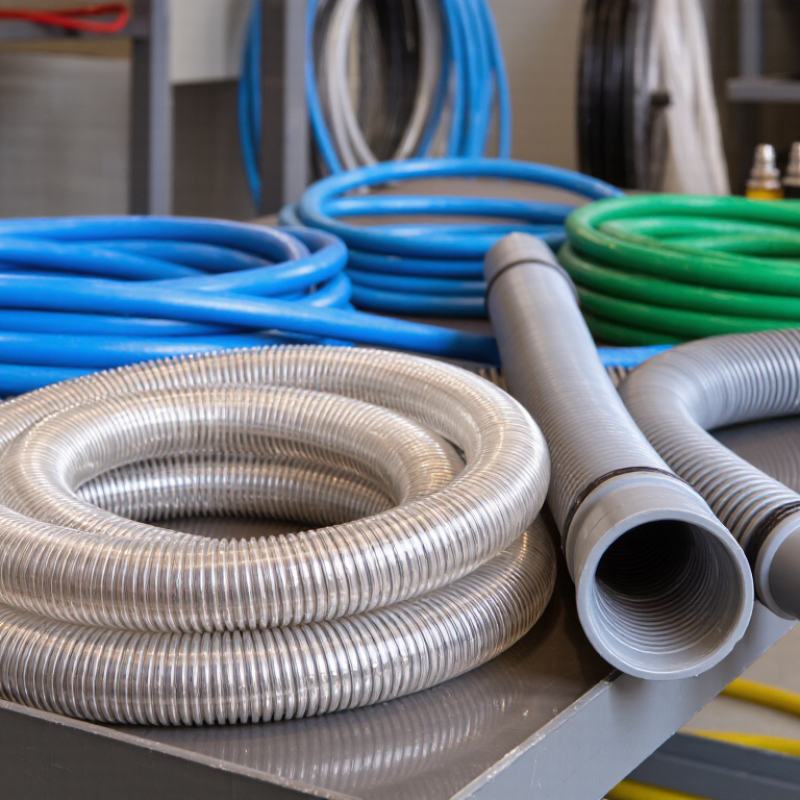
2026 Best PVC Hose Types for Industrial Buyers

What PVC Hoses Are and How They Function in Industrial Systems

PVC hoses are flexible conduits made from polyvinyl chloride, often softened with plasticizers. In industrial systems, they move water, air, or compatible fluids between pumps, tanks, and process lines. Polyester braiding can help the hose withstand internal pressure; a helical reinforcement can reduce collapse during suction. End fittings seal the connection. The hose’s pressure and temperature ratings matter.

PlasticsEurope’s Plastics – the Fast Facts 2024 report puts global plastics production at 413.8 million tonnes in 2023. This is broad material context, not a PVC-hose performance figure. In service, chemical compatibility and operating temperature are just as important as nominal diameter. A hose may look sound while its inner wall is degrading. That detail is easy to miss.

Tips: Check the manufacturer’s pressure and vacuum ratings against actual system conditions. Verify fluid compatibility and temperature limits, then inspect for cracks, swelling, or loose fittings. Do not assume a hose rated for water is suitable for every fluid. When conditions vary, leave a margin; sizing is not always straightforward.

Key Performance Factors for Comparing Industrial PVC Hoses

Industrial PVC hoses can look similar on a shelf, yet their pressure ratings depend on bore size, wall thickness, reinforcement, and temperature. Compare working pressure at the actual operating temperature, not just the highest figure on a product sheet. ISO 1402:2021 sets out hydrostatic test methods for rubber and plastics hoses, including tests relevant to pressure performance. Ask whether the listed value is a working, proof, or burst pressure; they are not interchangeable. A hose that handles water at room temperature may behave differently with warm fluids or repeated pressure pulses.

Check the media compatibility chart, minimum bend radius, and abrasion resistance against the task. A clear PVC wall helps operators spot trapped air or sediment, but clarity does not prove chemical compatibility. ISO 1307:2006 addresses hose dimensions and tolerances, making bore and fit useful comparison points when replacing a line. Leave room for temperature changes. PVC flexibility and pressure capacity can shift with heat and cold, so compare the rated limits for the exact hose construction. I would not trust one tidy catalog number alone. That is an imperfect habit, but it catches mismatches between a test result and a real installation. Keep the hose away from sharp frame edges, and inspect for flattening, cracks, or exposed reinforcement.

2026 Best PVC Hose Types for Industrial Buyers

Key Performance Factor: Typical Operating Temperature Range

Temperature ranges shown are representative of commonly published PVC hose specifications, not universal ratings. Actual limits depend on hose construction, size, pressure, and conveyed fluid; confirm the product datasheet before selecting a hose.

Common PVC Hose Types and Their Industrial Applications

PVC hose selection starts with the job, not the product label. General-purpose flexible hose handles water and light-duty air in workshops. Reinforced braided hose resists kinking under pressure, making it useful for compressors, washdown lines, and equipment connections. Check the working-pressure rating at the expected temperature; heat can reduce a hose’s pressure capacity.

Suction hose usually has a rigid spiral wall to resist collapse while moving water, slurry, or other compatible fluids. Layflat hose is easier to store and deploy across farms or construction sites, but it needs support against abrasion and sharp edges. Clear PVC hose helps operators spot flow or trapped debris. For chemical transfer, verify compatibility against the exact fluid and concentration. PVC is not suitable for every chemical.

PlasticsEurope’s Plastics—The Fast Facts 2023 reports global plastics production of 400.3 million tonnes in 2022. That figure covers plastics broadly, not PVC hose demand, but it shows the scale of material use behind many industrial products. A hose’s stated application is only a starting point. Fittings, UV exposure, cleaning methods, and repeated bending can change service life. That detail is easy to miss. A small bend radius can matter more than an impressive pressure rating.

How to Match Hose Construction to Operating Conditions

A hose that fits the connection can still be wrong for the job. Match its construction to the pressure, temperature, fluid, and movement it will face. Clear PVC tubing can help operators check flow or spot contamination, but it may not suit demanding pressure cycles. For compressed air or water transfer, braided reinforcement can improve pressure handling. Confirm the working-pressure rating at the actual operating temperature; heat can reduce capacity.

Suction lines need different support. A spiral-reinforced PVC hose resists collapse better under vacuum than ordinary flexible tubing. Check the suction level, bend radius, and whether the hose will drag across rough floors. Layflat hose is practical for temporary discharge because it stores compactly, though repeated abrasion may shorten its service life. Small details matter.

Compatibility deserves a real check. Oils, cleaning agents, and process fluids can affect PVC differently, so compare the exact fluid and concentration with technical data from the hose supplier. Also consider fittings, clamp pressure, and repeated flexing near connection points. A useful review starts with measured conditions, not a catalog label. In practice, operating conditions are not always steady; pressure spikes and tight bends are easy to overlook. Record them before choosing, and revisit the choice if the process changes.

2026 Best PVC Hose Types for Industrial Buyers - How to Match Hose Construction to Operating Conditions

Hose type Typical construction Best suited operating conditions Pressure and vacuum behavior Key selection considerations Common limitations
General-purpose braided PVC hose Flexible PVC tube with one or more textile-braid reinforcement layers and a PVC cover. Compressed-air lines, water transfer, light-duty pneumatic equipment, and general plant service when the conveyed material is compatible with PVC. Designed for positive pressure; the braid improves pressure handling compared with an unreinforced tube. It is generally not intended for sustained vacuum service. Check working pressure at the actual operating temperature, hose inside diameter, fitting compatibility, and whether the application involves pressure surges or repeated flexing. Pressure capacity decreases as temperature rises and can be affected by pulsation, kinking, abrasion, and chemical exposure. Do not use for breathing air unless specifically certified for that purpose.
PVC suction and delivery hose Flexible PVC wall with a rigid PVC helix or spiral reinforcement to help resist collapse. Water, slurry, powders, and other compatible materials in applications involving suction, discharge, or both. The helix helps maintain the hose shape under vacuum, while the hose wall and construction also determine its positive-pressure capability. Match vacuum rating, bend radius, hose diameter, conveyed-material abrasiveness, and the required end connections. Confirm that the selected hose is rated for the full vacuum level. Vacuum resistance can fall sharply if the hose is bent too tightly, heated, worn, or operated beyond its specified vacuum rating. It is not suitable for every solvent or chemical.
PVC layflat discharge hose Flexible PVC tube reinforced with textile yarns; the hose flattens when depressurized and expands during flow. Water discharge, irrigation, drainage, and temporary transfer where compact storage and quick deployment are useful. Primarily used for positive-pressure discharge. It is not a vacuum hose and should not be used for suction unless the manufacturer specifically rates it for that service. Consider working pressure, pump surge, abrasion at ground contact, coupling retention, and whether the hose must withstand outdoor exposure. Can kink or twist if incorrectly laid out. Pressure ratings depend on construction and temperature; protect it from sharp edges and prolonged contact with incompatible materials.
Steel-wire helix PVC hose PVC wall reinforced with a rigid steel-wire helix, sometimes combined with textile reinforcement. Industrial suction and transfer where increased shape retention is needed, including some liquid, granule, or powder handling duties. The wire helix supports vacuum resistance; positive-pressure capability varies by design and must be checked separately. Review the specified vacuum and pressure ratings, grounding or bonding requirements where relevant, minimum bend radius, and resistance of the lining to the conveyed material. The reinforcement can be damaged by crushing or excessive bending. Steel wire may corrode if exposed through a damaged cover or used in an unsuitable environment.
Food-contact PVC hose Food-contact-grade PVC formulation, commonly with textile reinforcement for pressure service; some designs are transparent for visual flow checks. Food or beverage transfer only when the complete hose assembly is certified for the intended food type, contact conditions, and jurisdiction. Pressure performance depends on the reinforcement and product design; food-contact status alone does not indicate a pressure or vacuum rating. Verify applicable food-contact documentation, temperature and cleaning limits, product compatibility, and whether the hose is approved for the specific beverage or process. Not every PVC hose is food-grade. Cleaning chemicals, repeated hot-water exposure, and operating conditions beyond the stated limits can affect service life and compliance.
Chemical-transfer PVC hose PVC tube with reinforcement selected for the intended pressure or suction duty; formulations and liners vary by product. Transfer of specifically listed acids, alkalis, salts, or other chemicals under the conditions stated by the hose manufacturer. Pressure and vacuum capability depend on the exact construction. Chemical compatibility does not establish a pressure rating. Check compatibility against the exact chemical, concentration, temperature, exposure duration, and cleaning procedure. Confirm the hose, fittings, seals, and assembly are all suitable. PVC is not universally resistant to solvents, oils, or aggressive chemicals. Do not select by generic chemical category alone; consult a compatibility chart and the manufacturer.
Unreinforced PVC tubing Single-wall flexible or semi-rigid PVC tube without textile or helix reinforcement. Low-pressure, low-demand routing such as drainage, protective sleeving, and compatible low-pressure fluid or air lines. Offers limited pressure capability compared with reinforced hose and is generally unsuitable for vacuum service. Check tube wall thickness, temperature range, bend radius, fluid compatibility, and whether the application requires a specified pressure rating. More prone to kinking, expansion, and collapse than reinforced constructions. Avoid using it for high-pressure, impulse, or safety-critical service unless specifically rated.

Selection note: PVC hose ratings vary by product construction, diameter, temperature, and manufacturer. Confirm the published working pressure, vacuum rating, temperature limits, chemical compatibility, and applicable safety or regulatory approvals for the complete hose assembly before purchase. Use working-pressure ratings rather than burst pressure when specifying normal operation.

Standards, Maintenance, and Purchasing Checks for 2026 Buyers

For 2026 purchasing, match the hose to the actual duty, not just its diameter. Record fluid, temperature range, working pressure, suction or vacuum needs, bend radius, and exposure to sunlight or abrasion. ISO 1307 provides dimensional requirements for certain rubber and plastics hoses; ISO 1402 describes hydrostatic pressure testing. Check the product’s stated scope before treating either standard as proof of suitability. PlasticsEurope’s Plastics—the Fast Facts 2024 reports 413.8 million tonnes of global plastics production in 2023. That figure is not PVC-hose data, but it underlines why material claims need careful checking. Small details matter.

Ask suppliers for test conditions, pressure ratings, temperature limits, and fluid-compatibility information in writing. Compare like with like: a pressure figure without temperature or test context can mislead. During maintenance, inspect the hose and couplings for cracks, bulges, flattening, soft spots, or leaks. Remove damaged sections from service and follow site procedures before inspection. Keep a simple log of installation dates and observed wear. A clean-looking hose is not necessarily sound. And one purchasing check is easy to miss: verify that the specified bend radius fits the real route, including around machine guards. Over-specifying can add cost; under-specifying can invite early failure. A datasheet helps, but it cannot replace checking the application.

Article Source:

Learn More

Connect with us today to learn more about our industrial automation solutions—and how to commission them for your application.