7 RF Power Amplifier Buying Tips for Buyers
Choosing an RF Power Amplifier is not just a matter of selecting the highest output rating. The right unit must match your frequency range, required power, signal type, and operating conditions. A mismatch can mean distorted signals, excess heat, or equipment that sits unused. Small details matter.
Before comparing models, define the job clearly. Note the frequency band, expected input level, gain, impedance, and whether the amplifier must handle continuous or pulsed operation. Check linearity and harmonic performance against your application’s needs. A headline power figure may look reassuring, but it does not tell the whole story. It can even distract from a poor match. That is easy to overlook.
This guide presents seven practical buying tips for evaluating specifications, cooling, connectors, controls, reliability, supplier support, and total cost. Product datasheets are useful, but confirm that their conditions resemble your real setup. Ask how measurements were taken, and request clarification when a rating lacks context. Where possible, plan a bench test using the intended load, cabling, and signal conditions. Keep the test record. It helps expose assumptions.
No checklist replaces sound engineering judgment, and not every buyer needs the most advanced model. A compact amplifier may suit a controlled laboratory setup, while a field system may need stronger thermal design and simpler service access. The trade-offs are rarely perfect. Use these tips to compare options consistently, identify questions early, and choose an amplifier that fits the work rather than the brochure.
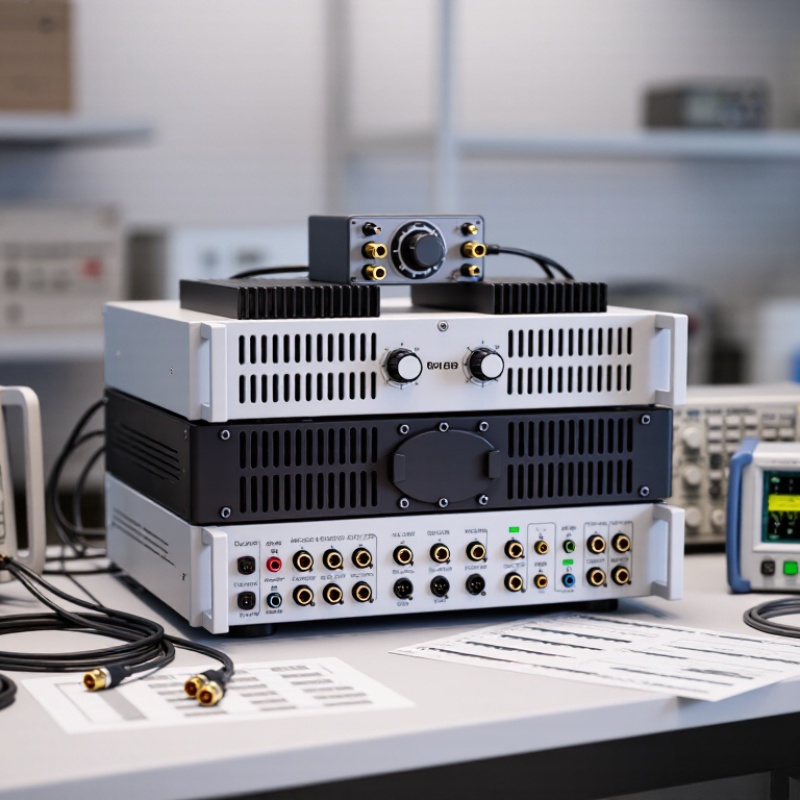
Define Your RF Power Amplifier’s Operating Requirements
Define the operating profile before comparing RF power amplifiers. Record the frequency band, required output power, signal type, duty cycle, and load impedance. Specify whether power means peak or average power at the amplifier output. A pulsed system and a continuous-wave system can need very different thermal designs. Small details matter.
Bandwidth and signal quality also shape the choice. 3GPP TS 38.104 lists NR channel bandwidths up to 100 MHz in FR1 and 400 MHz in FR2, depending on band and configuration. For modulated signals, include linearity targets such as error vector magnitude and adjacent-channel leakage, not just gain. Higher peak-to-average power ratio can require additional output headroom. A datasheet’s headline wattage may not describe performance under your waveform.
Tip: Write a one-line operating profile, such as “3.5 GHz, 20 W average, pulsed, 50-ohm load, specified modulation.” Then check every candidate against it. Also note ambient temperature, cooling limits, and how long the amplifier must run. One requirement is often overlooked: acceptable distortion. Revisit that assumption with the system designer before purchase.
Compare Frequency Range, Output Power, and Gain
When comparing RF power amplifiers, check that the stated frequency range covers your actual operating band. A broad range can look attractive, but performance may vary near its edges. Ask for gain and output-power data at the frequencies you plan to use, not only at a convenient center point. Small details matter. Confirm the required impedance and whether the specifications assume a particular load, input level, or test setup. If your signal spans several channels, compare response across the full span; one good measurement may hide uneven performance elsewhere.
Next, compare output power under realistic operating conditions. Note whether the figure is rated, typical, or a brief peak, and check the units carefully. Then assess gain: it indicates how much the amplifier raises input power, but more gain is not automatically better. Excess gain can make level control harder, while insufficient gain may require another stage. Check linearity, compression, and heat limits alongside the headline numbers. A datasheet may not match your installation exactly, which is easy to overlook. Allow for cable loss and ventilation, and ask the supplier for test conditions when they are unclear.
Assess Linearity, Efficiency, and Thermal Performance
When comparing RF power amplifiers, assess linearity at the output power you will actually use, not just at a headline rating. Check gain compression and adjacent-channel leakage across the intended frequency band, then repeat measurements with a realistic modulated signal. A device may look clean at low drive and distort near its operating limit. Leave margin. Confirm that datasheet conditions match your supply voltage, load, and ambient temperature; otherwise, comparisons can mislead.
Efficiency deserves equal scrutiny because wasted DC power becomes heat. Compare drain efficiency or power-added efficiency at several output levels; one attractive peak figure may hide weak performance during typical operation. Heat tells a story. Review thermal resistance, mounting requirements, and airflow, then monitor case temperature during sustained operation in the intended enclosure.
Numbers can mislead. Bench readings vary with fixtures and calibration, so record test conditions and repeat key measurements. Even a clean lab result can differ frustratingly from an installed unit. Consider which trade-off your system can cool, and verify it under realistic conditions.
Check Compatibility, Protection Features, and Compliance
Before comparing output power, check that the amplifier matches your system’s frequency range, impedance, and input signal level. A unit rated for the right frequency may still perform poorly if its connectors or operating bandwidth do not fit your setup. Confirm the expected load, cooling needs, and power supply requirements against your equipment documentation. Small mismatches matter. In practice, connector adapters can add loss, while restricted airflow can raise operating temperature. A datasheet can still leave gaps, so ask the supplier to clarify unclear ratings in writing.
Protection features deserve the same attention as headline performance. Look for safeguards against excessive temperature, reflected power, and overcurrent, then check how the unit responds when a limit is reached. Does it reduce output, shut down, or require manual resetting? That behavior affects both equipment safety and troubleshooting time. Also review the amplifier’s compliance documents for the intended market and installation. Requirements can vary by region and application, so verify current local rules rather than relying on a general claim. Keep test reports, operating limits, and maintenance instructions with the system records. A detail easy to overlook: confirm that protective functions remain active across the amplifier’s full operating range.
Evaluate Reliability, Support, and Total Cost of Ownership
When comparing RF power amplifiers, look beyond the quoted MTBF. Ask how it was calculated, at what temperature, and under what duty cycle. A rating without its test conditions is hard to use. Check thermal derating curves, fan replacement intervals, warranty exclusions, and repair turnaround. Picture a unit running in a warm rack: blocked airflow can turn a strong specification into an unexpected service call.
Support affects uptime. Confirm whether technicians can diagnose faults remotely, whether repair manuals and replacement modules are available, and how quickly service teams respond. Uptime Institute’s 2024 Annual Outage Analysis reported that 54% of respondents’ most recent significant outages cost more than $100,000. That finding is not specific to RF equipment, but it shows why downtime belongs in the buying calculation.
Calculate total cost of ownership across the expected service life. Include purchase price, electricity at your real operating load, scheduled maintenance, spare units, repairs, and replacement. NIST Handbook 135-2022, used in federal life-cycle cost analysis, provides a framework for comparing costs over time. Estimate energy use from actual duty cycles, not peak output alone. Then test the assumptions. Field conditions rarely match a clean spreadsheet.
