2026 Top Gummy Making Machine Types for Global Buyers
The global confectionery market is becoming more automated, traceable, and specification-driven. According to Grand View Research, the global gummy market is projected to expand strongly through 2030, supported by functional supplements, cleaner labels, and convenient formats. Fortune Business Insights also identifies gummies as a fast-growing segment within nutraceutical products. These trends are increasing demand for reliable Gummy Making Machine systems in 2026.
The leading machine types include starch mogul lines, starchless depositing systems, rope extruders, and compact batch production units. Each design suits different factory conditions. A starch mogul line handles broad product ranges and traditional shapes. Starchless machines reduce powder handling and support cleaner production areas. Depositors can control piece weight closely, often within tight gram-level tolerances. That matters when a line produces thousands of pieces per hour.
The stakes are practical. PMMI industry reports continue to highlight labor efficiency, digital monitoring, sanitation, and flexible packaging as major equipment priorities. Buyers should therefore examine heating accuracy, cooling performance, mold changeover time, CIP design, and spare-parts support. EU food hygiene rules and FDA requirements also make documentation essential, especially for export-oriented plants. Market forecasts are not purchase orders. Reported growth rates vary between research firms, and machine performance depends heavily on recipe viscosity, gelatin or pectin selection, and operator training. A glossy specification sheet can still mislead. This guide compares the top Gummy Making Machine types for global buyers, while recognizing that the cheapest option is rarely the most reliable long-term investment.
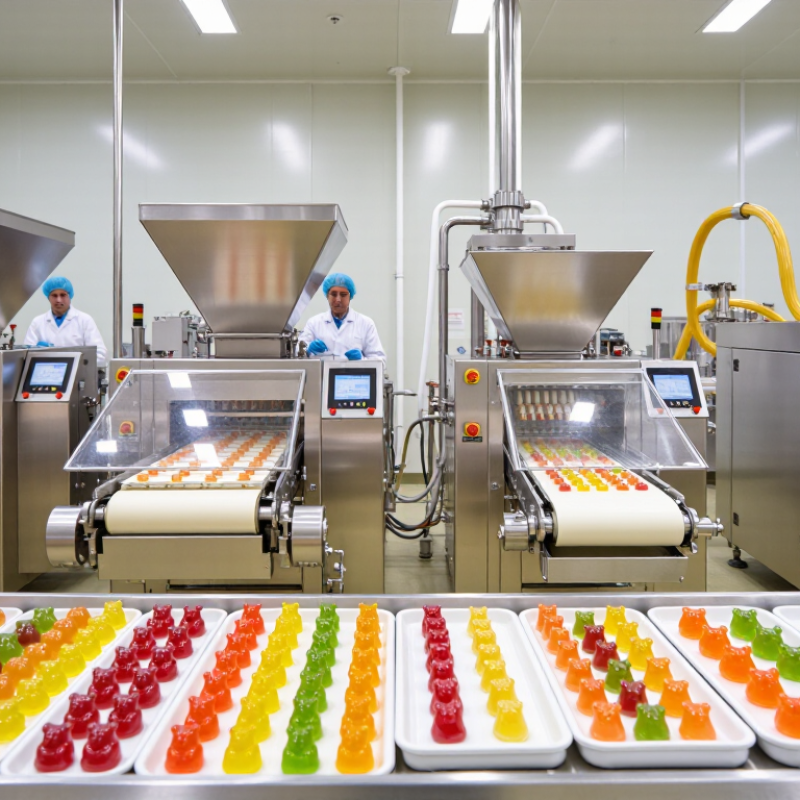
What Are the Main Gummy Making Machine Types in 2026?
2026 Top Gummy Making Machine Types for Global Buyers
The main gummy making machine types in 2026 differ by forming method, product shape, and output needs. Starch mogul lines deposit hot gummy mass into starch-filled trays. They suit large volumes and traditional shapes. Starchless depositing machines use reusable silicone or metal molds. They offer cleaner handling, faster mold changes, and sharper details. The choice is not purely technical.
According to Fortune Business Insights, the global gummy market was valued at about USD 21.68 billion in 2023. Its report projects strong growth through 2032, increasing demand for flexible production equipment. This trend supports multi-color, filled, vitamin, and sugar-free gummy formats. However, market growth does not mean every factory needs the largest line.
Three-dimensional gummy machines create layered or character-shaped products. Rope extrusion and cutting equipment forms continuous gummy ropes, then sizes them into uniform pieces. Some integrated lines combine cooking, depositing, cooling, demolding, oiling, and packaging.
The categories overlap in real factories. That matters. A starchless line may reduce starch recovery work, but its molds can raise replacement costs. A high-speed system may also waste materials during flavor changes.
PMMI packaging reports repeatedly emphasize automation, changeover efficiency, and labor reduction as major investment factors. Buyers should compare verified hourly output, mold life, cleaning time, temperature control, and energy use. Sales brochures often show perfect pieces. Production rarely stays perfect.
Depositing Machines: 20–60 Molds per Minute and ±2% Dosing Accuracy
Depositing Machines: 20–60 Molds per Minute and ±2% Dosing Accuracy
For global gummy producers, depositing machines must balance speed, portion control, and repeatable production. Modern systems can serve 20 to 60 molds per minute, depending on mold size, recipe viscosity, and filling volume. The stated ±2% dosing accuracy is valuable for consistent weight and predictable ingredient use. It should not be accepted blindly. Buyers need factory trials with their actual gummy mixture.
Temperature control affects performance more than many purchasing teams expect. A warm, stable hopper can keep gelatin-based syrup flowing smoothly, while excessive heat may change texture or color. Servo-driven depositing pistons can place measured amounts into starchless or traditional molds. Operators should inspect nozzle alignment, piston seals, and mold indexing during each shift. Small timing errors become visible when hundreds of pieces pass through the line.
A practical acceptance test may compare 30 consecutive pieces from several depositing heads. Record individual weights, average deviation, and any incomplete cavities. Cleanability also matters, especially around valves and heated product paths. Some machines promise high speed, yet the real output falls after changeovers or recipe adjustments. That gap deserves honest review. Reliable equipment needs skilled operators, documented calibration, and regular maintenance, not speed alone. A slower line with stable dosing may protect product quality better._久久爱
Starch Mogul Systems: 10,000–30,000 Gummies per Hour
Starch mogul systems can produce 10,000–30,000 gummies per hour, making them practical for growing confectionery operations. Their stated capacity depends on mold size, recipe viscosity, depositing speed, and cooling time. In practical production trials, operators often see lower output during startup or recipe changes. Small adjustments can affect filling accuracy and product weight.
The number is impressive, but it is not guaranteed. Buyers should verify real output using their preferred gummy size and formulation. This matters.
A reliable system should control starch conditioning, tray movement, depositing, cooling, and demolding with steady timing. The starch bed must remain dry enough to hold clean shapes. Excess moisture may cause sticking, uneven surfaces, or damaged pieces.
Temperature and humidity controls deserve careful attention in warm production areas. If the starch is too compact, gummy release becomes slower.
Cleaning also deserves practical inspection. Some equipment looks efficient but takes too long to access and sanitize. That compromise hurts daily productivity.
Before purchase, ask for a production test using similar ingredients and mold dimensions. Request records for hourly output, waste levels, temperature stability, and changeover time. A short pilot can reveal more than a catalog specification. It may also expose weaknesses that sellers do not emphasize.
Rope Extrusion Lines: 50–150 kg per Hour for Continuous Production
2026 Top Gummy Making Machine Types for Global Buyers
Rope extrusion lines suit gummy producers needing continuous output rather than intermittent batches. Typical systems deliver 50–150 kg per hour, depending on recipe, rope diameter, cooling time, and cutting speed. An eight-hour shift therefore produces 400–1,200 kg before downtime. With 85% practical availability, usable output falls to approximately 340–1,020 kg daily. That difference matters.
Grand View Research valued the global gummy market at about USD 19.4 billion in 2023, with strong projected growth through 2030. IMARC Group reported a higher 2023 estimate, near USD 21.5 billion, because market definitions differ. These figures indicate demand, not guaranteed machine utilization. Buyers should examine regional sales forecasts, seasonal orders, and labor costs before selecting capacity.
A dependable rope line normally includes cooking, extrusion, sizing, cooling, oiling, and cutting sections. Food-grade contact surfaces, temperature logging, and cleanable conveyor designs support safer production and easier audits. I would not accept a 150 kg/h claim without test conditions. Ask for viscosity, moisture, rope size, cooling temperature, and actual yield data. Small gummy pieces can expose poor sizing quickly. A 50 kg/h line may be wiser for variable recipes, while 150 kg/h requires steady demand, trained operators, and sufficient cooling space.
2026 Top Gummy Making Machine Types for Global Buyers - Rope Extrusion Lines: 50–150 kg per Hour for Continuous Production
| Line Type | Nominal Output | Typical Rope Diameter | Rope Channels | Approx. Line Speed | Cooling Tunnel | Installed Power | Typical Footprint | Recommended Use |
| Compact Single-Rope Line | 50–70 kg/h | 8–18 mm | 1 | Approximately 0.8–2.0 m/min | 4–6 m | 25–45 kW | 9–14 m × 1.2–1.8 m | Pilot plants, small confectionery factories, and new product development |
| Standard Single-Rope Line | 70–100 kg/h | 10–22 mm | 1 | Approximately 1.0–2.5 m/min | 6–8 m | 35–60 kW | 12–18 m × 1.5–2.0 m | General-purpose continuous production of uniform gummy ropes |
| Multi-Rope Extrusion Line | 90–130 kg/h | 8–20 mm per rope | 2–4 | Approximately 0.8–2.2 m/min per channel | 8–12 m | 55–85 kW | 16–24 m × 1.8–2.5 m | Higher-volume production with multiple colors, flavors, or rope sizes |
| High-Output Multi-Color Line | 120–150 kg/h | 10–24 mm per rope | 3–6 | Approximately 1.0–2.5 m/min per channel | 10–16 m | 75–110 kW | 20–30 m × 2.0–3.0 m | Large continuous runs, layered ropes, and multi-color gummy products |
Technical note: Output, rope speed, cooling length, power demand, and footprint are typical engineering ranges for continuous gummy rope extrusion systems. Actual performance depends on recipe solids content, gelatin or pectin system, rope diameter, product temperature, cooling conditions, and the required cutting or forming method.
How GMP, HACCP, CE, and 21 CFR 117 Shape Global Machine Selection
In 2026, gummy manufacturers will compare more than output speed. They will examine rotary depositors, starch moguls, and servo-controlled forming systems. GMP influences every contact surface, access panel, and cleaning procedure. A machine should support hygienic design, consistent dosing, and documented maintenance. Stainless steel alone is not enough.
HACCP changes the selection process further. Buyers should identify hazards around heating, cooling, filling, and allergen changeovers. Useful machines allow clear inspection points and reliable temperature records. Tool-free dismantling can reduce cleaning errors. It can also expose weak operator training. That detail is often overlooked.
CE marking matters for applicable European safety requirements, but it does not prove food compliance. Buyers should review the declaration, risk assessment, guards, and electrical documentation. For the United States, 21 CFR 117 emphasizes current good manufacturing practices and preventive controls. The machine must fit the facility’s broader food safety plan. Ask for material certificates, cleanability evidence, calibration records, and factory acceptance testing. A polished brochure is not sufficient evidence. In practice, one selection may still need redesign after site trials. That is not failure. It is a useful warning that capacity figures rarely reflect real products, sticky formulas, or frequent flavor changes.
