Connect with us today to learn more about our industrial automation solutions—and how to commission them for your application.
2026 Best Power Tool Accessories for Global Buyers
Choosing the right Power Tool Accessories in 2026 requires more than comparing prices or browsing attractive product photos. Global buyers need reliable performance, clear specifications, and dependable supply conditions.
A practical assessment starts with the jobsite. A masonry drill bit should survive concrete dust, while a circular saw blade must maintain clean cuts through plywood, hardwood, or composite panels. Small details matter. Shank size, thread type, coating, tooth geometry, and heat resistance can determine whether an accessory fits safely and performs consistently. Experienced purchasers should request samples, review test data, and check compatibility with specific tool models.
Availability also deserves close attention. Export packaging should protect cutting edges, batteries, and precision components from moisture and impact. Suppliers should provide traceable materials, consistent batch quality, and documentation suited to the destination market. Independent testing and recognized quality systems can strengthen confidence, but certificates never replace practical inspection.
There is no universal best choice. A premium accessory may reduce downtime, yet a lower-cost option can work well for occasional use. Sometimes, catalog descriptions sound more convincing than real workshop results. That is why a controlled trial remains valuable. Test the accessory under realistic pressure, record wear, and compare total operating cost instead of purchase price alone.
This guide examines leading accessory categories for drills, grinders, saws, sanders, and fastening tools. It focuses on durability, compatibility, safety, logistics, and value for international buyers. Some recommendations may change as materials, tool platforms, and regional requirements develop. Careful verification remains essential.
Power Tool Accessory Categories and Their Core Functions
Global buyers need more than a long accessory list. They need clear functions, verified fit, and predictable service life. Grand View Research estimates the global power tools market reached about US$36.5 billion in 2023, with continued growth through 2030. MarketsandMarkets also forecasts steady expansion, although its figures differ because market definitions vary. Reports are not perfectly aligned.
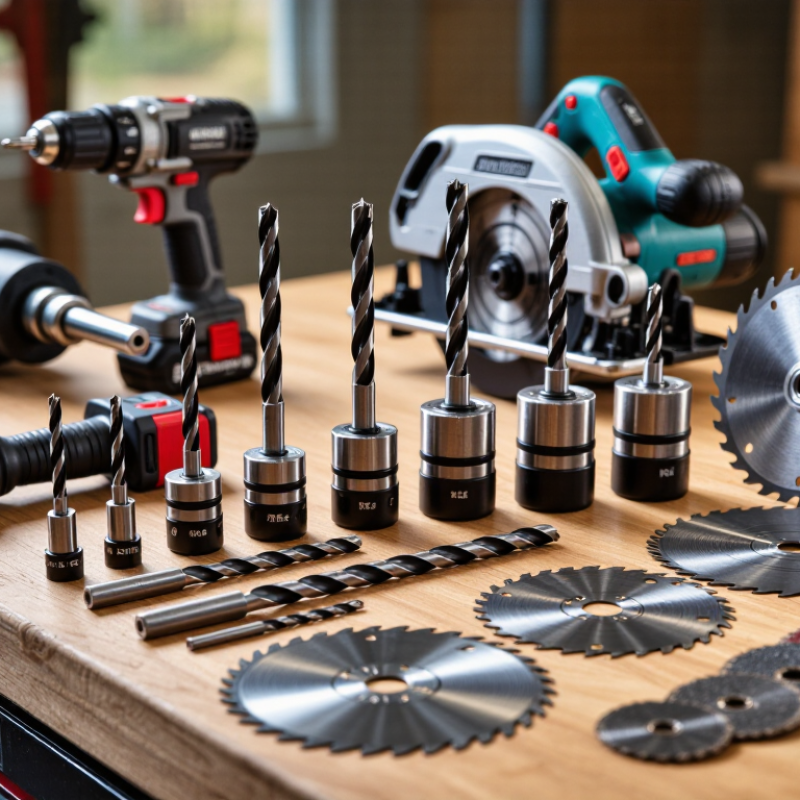
Drill and driver bits create holes and drive fasteners. Masonry bits require carbide tips for concrete and brick. Twist bits suit metal and general-purpose drilling. Saw blades control cutting speed, finish, and material compatibility. Fine-tooth blades reduce splintering in wood. Coarse blades remove material faster. Choose carefully.
Grinding wheels and cutting discs remove stock, clean welds, or separate metal. Their thickness affects control and cutting speed. Sanding discs refine surfaces, while polishing pads improve appearance without removing much material. Hole saws produce larger openings for pipes and wiring. Abrasive products need correct diameter, speed rating, and mounting fit.
In field purchasing, compatibility failures cause more delays than modest price differences. Fit matters more. A low-cost bit may perform well once, then overheat quickly. Dust-extraction accessories improve visibility and reduce airborne particles during drilling or sanding. Still, extraction cannot replace suitable protective equipment or proper ventilation. Product descriptions should state material use, dimensions, operating limits, and tested applications. Heat tells a story. That detail is often ignored.
How to Match Accessories with Tools, Materials, and Applications
Choosing the right accessory begins with the tool, not the product photo. Check the tool’s power, speed range, chuck type, shaft size, and connection system. A drill bit for masonry needs a different tip than one for hardwood or stainless steel. Fit matters. A loose connection can cause vibration, uneven holes, or premature wear.
Material changes the selection further. For concrete, use a carbide-tipped bit matched to the required hole diameter. For thin metal, choose a sharp, heat-resistant cutting accessory and reduce pressure. For wood, a clean-edged bit helps prevent splintering. Dust changes everything. In workshops, I often match extraction accessories before choosing the final cutting head, especially during long sanding tasks.
Application details also deserve attention. A small fastening job may need a torsion-resistant bit, while repeated production work demands stronger wear resistance. Confirm the accessory’s rated speed and the tool’s operating limits before use. I have seen buyers focus on price and overlook replacement availability, packaging quality, or regional size standards. That mistake costs time. Compatibility charts help, but they are not perfect; samples should be tested on the actual material. Check the finish, temperature, vibration, and cutting speed during a short trial. A careful trial may reveal that the “universal” accessory is only suitable for occasional work.
Key Performance Standards for Professional and Industrial Use
2026 Best Power Tool Accessories for Global Buyers
Key Performance Standards for Professional and Industrial Use
Professional accessories must withstand heat, vibration, impact, and repeated loading. A cutting blade should keep its edge after long contact with dense material. A drill bit needs stable geometry, clean flutes, and controlled hardness. Excessive runout creates rough holes and dangerous vibration. Precision matters.
In practical workshops, buyers should check torque ratings, impact resistance, dimensional tolerances, and operating temperature ranges. For abrasive products, test records should confirm strength, balance, and controlled wear. For sockets and adapters, material hardness must support repeated torque without cracking. Compatibility data should state sizes, connection types, and approved tool classes clearly.
Small details matter.
Reliable suppliers provide batch traceability, inspection records, and practical storage guidance. Packaging should protect edges from moisture and deformation during international transport. I have seen accessories fail early because users ignored storage conditions, not because the design was poor. That lesson deserves attention. No accessory survives every misuse. Buyers should also compare real service life, not only purchase price. A cheaper item may increase downtime, rejected work, and replacement costs. Independent testing can improve confidence, although one test cannot represent every jobsite. Standards and certificates help, but experienced users should still examine samples, fit, finish, and performance under realistic loads.
Regional Compatibility, Safety Rules, and Certification Requirements
For global buyers, accessory compatibility starts with measurements, not packaging claims. Check voltage class, arbor diameter, thread pitch, shank profile, maximum RPM, and guard requirements. A 115 mm disc may not fit a 125 mm guard. Battery interfaces also require matching voltage, terminals, communication controls, and charging systems. IEC 62841 covers safety requirements for many hand-held and transportable motor-operated tools, but it does not make every accessory universally interchangeable. That distinction matters. In sourcing audits, a clear fitment table often prevents more failures than a long product description.
Regional rules add another layer. In European markets, importers should verify applicable electrical legislation, technical files, risk assessments, and CE obligations before sale. For Great Britain, conformity routes may differ. In the United States, electrical equipment often needs evaluation by an OSHA-recognized NRTL. Do not treat one test mark as a global passport. The European Commission’s Safety Gate 2024 report recorded 4,137 alerts, showing that product surveillance remains active. Accessories with batteries, cutting edges, dust exposure, or high-speed rotation need stronger documentation.
The U.S. Bureau of Labor Statistics reported 2.6 million nonfatal recordable workplace injury and illness cases in private industry during 2023. This figure covers all sectors, not power tools. That limitation matters. Buyers should request test reports, batch traceability, local-language instructions, and evidence for material restrictions such as RoHS or REACH. Ask whether stated RPM means no-load or operating speed. Small details become expensive. I would recheck standards at every shipment, because a redesigned accessory may escape an old compliance file.
Buying Criteria for Global Sourcing, Logistics, and Long-Term Value
For 2026 global sourcing, power tool accessories should be judged beyond unit price.
I have learned this through supplier audits, sample testing, and delayed shipments.
A reliable sourcing process begins with measurable specifications. Check material grade, dimensions, tolerance, surface treatment, and compatibility details. Request production samples from the same line used for bulk orders. Catalog photos can hide poor fitting or uneven edges.
Logistics can quietly destroy a profitable purchase. Ask for carton dimensions, gross weight, pallet limits, and realistic production dates. Confirm packaging strength with a simple drop test. Small boxes, corner protection, and moisture-resistant labels can reduce warehouse damage.
Review customs classifications, origin documents, safety test reports, and agreed trade terms before payment. I prefer written records because verbal promises become weak during a dispute. Container planning also matters. A low-cost accessory may waste space when packed inefficiently.
Long-term value depends on performance after repeated use. Test wear, heat resistance, fastening strength, and storage stability when relevant. Compare failure rates, replacement availability, warranty handling, and communication speed.
The cheapest option is often expensive later. I once approved a promising sample without checking batch consistency, and the second shipment performed differently. That mistake changed my process. Now, I require an inspection plan, retained samples, and clear acceptance limits before larger orders.
A small pilot order may feel slower, but it reveals problems while they remain affordable.